Tankless water heater installation in Calgary: what actually has to change in your house
Written for Calgary homeowners · Last reviewed September 14, 2026
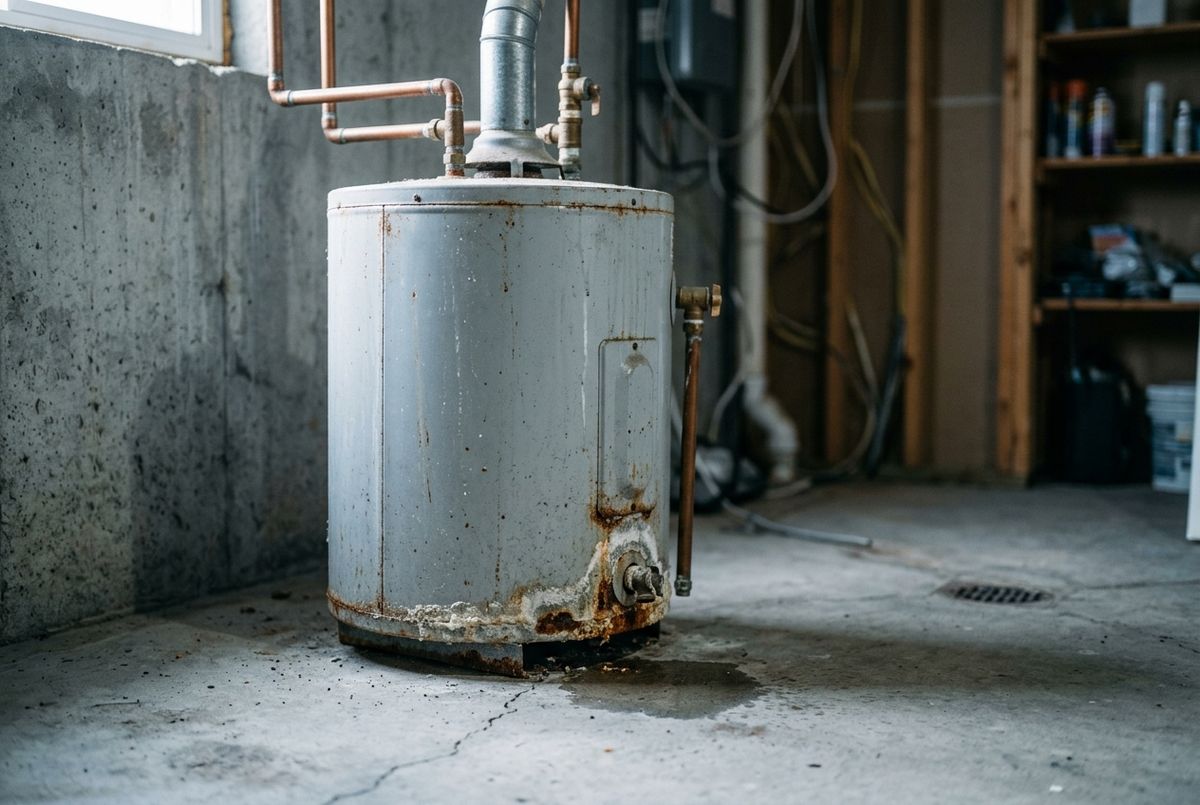
Short answer: converting a Calgary house from a storage tank to tankless is not an appliance swap. It is a gas job, a venting job, an electrical job and a drainage job that happen to end with a water heater on the wall. Your gas line, your chimney and your floor drain decide the price — not the brand on the box. Calgary companies publish installed figures around $3,500 to $7,000, self-reported and unaudited, and that gap is almost entirely the four things below.
Still deciding whether to do it at all? We published the annual energy arithmetic on tank versus tankless running costs, working shown.
Four things change, and each one has a price attached
1. The gas supply, which is the big one
A storage tank draws roughly 40,000 BTU an hour, slowly, reheating a reservoir. A tankless unit has no reservoir, so it makes the heat the moment you open the tap. The condensing units sold here are rated up to 199,900 BTU/h — about five times the demand, all at once, through whatever pipe is already there.
And it only works inside a narrow pressure band: 3.5 to 10.5 inches of water column at the inlet for natural gas. Not at 2 a.m. with nothing else running — at dinner time, furnace firing, range on. An undersized line does not stop the unit starting; it makes it misbehave on exactly the coldest mornings you bought it for.
Source: Navien — NPE Series installation manual and Rinnai — N Series residential condensing installation and operation manual.
For many Calgary homes that means a larger-diameter run from the meter, sometimes a question about the meter itself. We could not verify ATCO's process for adding load to an existing residential service — its published pages would not render for us, and we will not describe a process we have not read. [CONFIRM ATCO LOAD-CHANGE PROCESS] Ask your gasfitter whether the meter is being touched, before you pay a deposit.
2. The venting, which cannot reuse your chimney
This is the surprise, because the old flue is sitting right there looking serviceable. A condensing unit pulls so much heat out of the exhaust that what leaves is cool and wet rather than hot and buoyant — it will not rise up a masonry or B-vent chimney, and it will corrode one. The manufacturers list Schedule 40 PVC, CPVC or approved polypropylene, out through an exterior wall, with maximum lengths that shorten with every elbow.
Source: Navien — NPE Series installation manual (approved vent materials and maximum vent lengths).
So somebody is cutting a hole in your wall, and where matters: a sidewall termination here needs clearance from windows, walkways and anything that minds being rained on by warm vapour at −25 °C. Pick the wall with the installer standing beside you.
3. The condensate, which has to go somewhere legal
That same efficiency produces liquid water, continuously, and it is not neutral. Navien puts the condensate's pH at 3 to 5 — acidic enough that the manual sells a neutralizer kit and says to replace the media once pH drops below 6.0. So the unit needs a correctly sloped drain within reach, which usually means it wants to live near the floor drain or laundry standpipe, not in the corner where the tank was. If the drain is across the room, that line is real work and belongs on the quote.
Source: Navien — NPE Series installation manual (condensate pH and neutralizer media replacement).
4. The electrical, which the old tank never needed
A gas tank with a standing pilot runs on nothing. A tankless unit needs 120 volts for controls, fan and ignition, so if there is no outlet where it is going, you need one — and your endless hot water is now tied to the grid. In a Calgary outage you have neither hot water nor a tank full of it left over.
Source: Rinnai — N Series residential condensing installation and operation manual (120 V AC electrical supply).
The chimney question to ask out loud. If your tank shared a flue with an older mid-efficiency furnace, pulling the tank out leaves that furnace venting alone up a chimney sized for two appliances. We could not find a plain-language City or Alberta publication settling what has to happen next, so we will not state a rule we cannot cite — but it is a known scenario, it is not free, and it is the classic mid-job surprise. Get it addressed in writing on the quote; call 311 for the City's own read.
The hard-water problem no Calgary tankless page prints a number for
Every tankless page in this city mentions hard water. None we read put the manufacturer's limit beside the City's measurements — odd, because both are published and they do not agree.
Navien and Rinnai both specify a maximum total hardness of 200 mg/L, about 12 grains per gallon. Rinnai is blunt about the consequence: in an area known for hard water or scale build-up, the water must be treated. Navien ties water outside its stated quality range to warranty exposure.
Sources: Navien — NPE Series installation manual; Rinnai — N Series residential condensing installation and operation manual.
Here is what the City measured leaving its two plants in 2025, against that line.
| Quarter | Bearspaw plant | Glenmore plant | Over the 200 mg/L limit? |
|---|---|---|---|
| January–March | 151–200 | 208–274 | Glenmore, entirely |
| April–June | 141–192 | 181–245 | Glenmore, mostly |
| July–September | 151–177 | 191–216 | Glenmore, partly |
| October–December | 168–197 | 213–248 | Glenmore, entirely |
Source: The City of Calgary — Water quality, water hardness and water data (2025 figures, re-checked September 2026).
Read the right-hand column again. Glenmore water sat above the manufacturers' ceiling in all four quarters of 2025, and Bearspaw reached it twice. That does not mean tankless units fail here — plenty run for years. It means that across a large part of this city, installing one with nothing in front of it puts the appliance outside its maker's published water spec on day one. That is a warranty conversation to have before you sign, not after a heat exchanger fails.
Which plant serves your street decides where you sit, and the City publishes the hardness data but not a neighbourhood-by-plant map — so ask 311 rather than letting anyone guess. On the hard side the options are treating the incoming water or flushing far more often than the brochure implies: water softener installation covers the first, the Calgary hard water page covers why this kills equipment here. Either way, fit isolation valves at install time — cheap in the original job, irritating to retrofit, and without them every flush is a plumbing call.
Permits: this job triggers them, and you can't pull your own
The City names three conditions requiring a permit for water heater work: changes to the gas lines upstream of the water heater shut-off valve, changes to the venting system's size or design, and a change to the type of water heater. A tank-to-tankless conversion does all three at once — one of the few water heater jobs with nothing to argue about.
Source: The City of Calgary — Homeowner electrical and plumbing permits.
The part that surprises DIY-minded owners: this is gas work, and homeowners cannot take out a gas permit on their own house unless they are a first- or second-class gasfitter. Plumbing and gasfitting are separate tickets in Alberta — what you can legally do yourself is here, and the full permit triggers are here.
Source: The City of Calgary — Plumbing and gas permits: "If you are a homeowner, you may apply for all permit types except for a gas permit."
Ranking Calgary pages describe the permit for this job as "$100 to $150." That is the homeowner plumbing permit — $116.50 ($112 plus a $4.50 Safety Codes Council fee) as of September 2026 — and it is not the permit that applies to you, because you cannot pull it for gas work. Contractor trade permits are priced on the value of the work. Ask to see the permit as its own line on the invoice.
What it costs, and where those numbers come from
There is no authoritative public source for Calgary tankless pricing. Every figure below is a company's self-report on its own marketing page — planning ranges for budgeting, not quotes.
| What's published | Figure | Who published it |
|---|---|---|
| Supply and install, one unit | From $6,495 + GST | A Calgary installer's product page |
| Full job, itemised | $3,500–$7,000 | A Calgary company's step-by-step guide |
| — of which gas line upgrade | $500–$1,200 | same source |
| — of which venting work | $400–$800 | same source |
| — of which electrical | $300–$800 | same source |
The spread tells you more than the numbers do: equipment is the predictable part, and the $3,500 house and the $7,000 house are separated almost entirely by gas, venting and drainage. Which is why a price quoted over the phone is not a quote. What Calgary plumbers charge has the labour context; the tank replacement page covers the like-for-like alternative.
Before you sign anything
A tankless unit is rated in flow at a given temperature rise, not in litres of storage — so how big it really is depends on the water temperature arriving at your house in the worst month of the year.
We could not verify a Calgary winter mains water temperature from any primary source. The City does not appear to publish one, and we will not lift a figure off an American sizing calculator and dress it up as local. Ask 311 — and make the installer commit in writing to the inlet temperature they sized on. If it is a summer number, the unit is smaller than you think between November and March.
Then get these five itemised separately — they are where the quotes actually differ.
- Gas. Model, maximum input, total meter load, pipe size and length — so you know whether the upsize is priced or discovered later.
- Venting. Which wall it exits, run length and elbows, and who deals with the old chimney — so the hole in your house is a decision you made.
- Condensate. Where it drains and whether a neutralizer is included — so the acidic discharge is handled, not quietly pointed at your floor drain.
- Electrical. Whether the 120 V outlet exists or is being added — so it is priced now, not as a change order on install day.
- Isolation valves and water treatment. Both, quoted separately — so you can flush it yourself, and so the hardness warranty question has an answer on paper.
And before any of it, make sure the old tank is actually the problem — a failed thermocouple is a cheap repair, not a reason to spend thousands. If there is no hot water this week rather than a plan for next month, start at the no hot water page; if water is spreading across the floor, shut the supply off and call. For where this sits among everything else that goes wrong in Calgary housing stock, start at our main plumbing page.
Cheap conversion or expensive one? It depends on your house.
The honest answer needs eyes on your gas meter, your mechanical room and the wall the vent has to pass through. We will tell you which of the four items apply, what they cost, and when a tank is the better call. No obligation.
Questions Calgary homeowners actually ask
The quote says my gas line has to be upsized. Is that real or is it padding?
It's usually real, and it's the single biggest reason two quotes on the same street come out thousands apart. Your storage tank is somewhere around 40,000 BTU an hour. The tankless units sold here go up to 199,900. That's roughly five times the gas, through the same pipe, at the same moment — and the unit only works if it still sees between 3.5 and 10.5 inches of water column at its inlet when the furnace and the stove are also running.
What you can do is make them show their work. Ask which model, what its maximum input is, what the total connected load on your meter becomes with it added, and what size and length of pipe they're proposing. A gasfitter who has actually sized it will answer that in about thirty seconds. One who hasn't will change the subject to the warranty.
Can I just reuse the chimney the old tank vented into?
No, and this catches people out because the chimney is right there and it looks like it's doing nothing now. A condensing tankless unit doesn't push hot gas up a flue; it pulls almost all the heat out of the exhaust, which leaves it cool and wet. The manufacturers' own manuals list plastic pipe — Schedule 40 PVC, CPVC or approved polypropylene — going out through a wall, not clay or metal going up.
The part worth asking about before the truck leaves is the other end of it. If your old tank shared that chimney with an older mid-efficiency furnace, taking the tank out leaves the furnace venting up a flue that was sized for both. We couldn't find a plain-language City or Alberta document that settles what has to happen next, so don't take our word for it — ask the installer, in writing, what they intend to do about the chimney, and get it on the quote rather than discovering it in November.
Everyone says Calgary water is hard on tankless. How hard is too hard?
There's an actual number, and almost nobody around here prints it. Navien and Rinnai both publish a total hardness limit of 200 mg/L in their installation manuals — that's about 12 grains per gallon. Above it, you're expected to treat the water, and Rinnai says so flatly: if the area is known for hard water, the water must be treated.
Now put the City's own numbers next to that. Glenmore plant water ran 181 to 274 mg/L through 2025 — over the line in every single quarter. Bearspaw ran 141 to 200 and touched it twice. So for a good chunk of this city, a tankless unit installed with nothing in front of it is running outside the maker's published water spec from day one. That doesn't mean it explodes. It means scale, more flushing, and a conversation about the warranty that you'd rather have now than in year six.
Which treatment plant supplies my house? I want to know where I sit on that hardness range.
Fair question and we can't answer it for you. The City publishes the hardness numbers for both plants but doesn't publish a map of which neighbourhoods get which water, and we're not going to guess at it — guessing is how a page like this ends up wrong in a way nobody catches.
Call 311 and ask which plant serves your address. It's a two-minute call and it changes the answer materially: the difference between the bottom of the Bearspaw range and the top of the Glenmore range is nearly double the hardness, which is the difference between a softener being optional and it being the thing that decides whether your warranty survives.
Do I need a permit, and can I pull it myself to save the fee?
You need one, and no, you almost certainly can't pull it yourself. The City lists three things that trigger a water heater permit — changing the gas lines upstream of the water heater shut-off, changing the venting system's size or design, and changing the type of water heater. A tank-to-tankless conversion does all three at once, so there's no argument to be had about it.
The catch is that it's gas work, and the City is blunt about that: homeowners can't take out a gas permit on their own house unless they happen to be a first- or second-class gasfitter. Everyone else hires a licensed contractor who pulls it. Ignore the pages telling you the permit runs $100 to $150 — that's the homeowner plumbing fee, which isn't the fee you'll be paying. Contractor trade permits are priced off the value of the work, and your installer should be showing you that line on the invoice, not burying it.
How do I compare three tankless quotes when they're all wildly different?
Strip out the brand names, because the equipment is the part everyone quotes honestly. The spread is in the work. Ask each of them to itemise five things separately: the gas line and anything the meter needs, the venting and where it exits the wall, the condensate drain, the 120-volt outlet, and the isolation valves for flushing. Whoever leaves one of those out isn't cheaper — they've just moved it to a change order.
Then ask one question that sorts them fast: what inlet water temperature did you size this on? A tankless unit's rated flow is a function of how far it has to lift the incoming temperature, and Calgary's winter mains temperature isn't something we could find published anywhere official. If they've assumed summer water, the unit will be fine in July and disappointing in January, and you'll have paid for capacity you never had.