Sewer line repair in Calgary: what decides the price, and who's actually allowed to dig
Written for Calgary homeowners · Last reviewed September 21, 2026
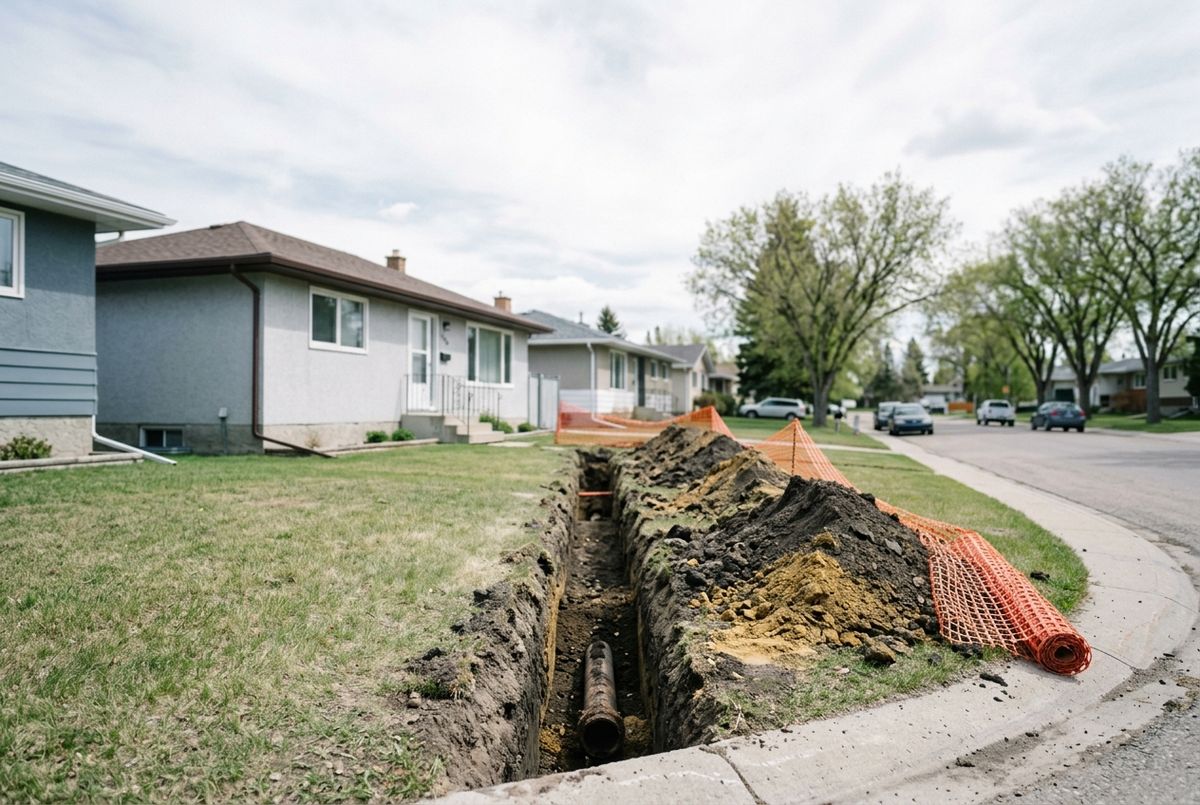
Short answer: the price has little to do with the pipe and almost everything to do with what sits on top of it. A metre of lawn is cheap. A driveway, a sidewalk, a City road or a mature boulevard elm each add a permit, a contractor restriction or a restoration bill — which is why the same broken clay tile costs wildly different amounts two streets apart, and why the City publishes no price for this work, saying only that the cost "can be highly variable, depending on the contractor and type of… repair."
Source: The City of Calgary — Water service line leaks in Calgary. That wording is about the water service — the City publishes no equivalent guidance for private sewer lines at all.
This page is the repair job itself. Not sure the broken section is yours to pay for? Start at who owns which pipe. Sewage coming up a floor drain right now? Deal with that first.
Two families of repair, and what each one buys you
Open-cut: dig a trench to the pipe
A machine opens a trench along the line, the damaged length comes out, new pipe goes in, the hole is backfilled and the surface restored. Often still the right call: if the line has collapsed, sagged into a belly, or the ground above is coming up anyway, digging is direct and the pipe is fully exposed, so the crew can see what they are connecting to.
The cost is above ground. Lawn, driveway, sidewalk, fence, garage slab, road: whatever the trench crosses has to be reinstated, and that is frequently a bigger invoice line than the pipework.
Trenchless: reach the pipe through small pits
Calgary companies offer three variations, and the City uses the same vocabulary for the equivalent water-service work: a pull or burst that draws new pipe through the old, excavation where that is not possible, and a spot repair using a hydrovac — pressurised water and a vacuum — to expose the pipe only at the damaged point.
Source: The City of Calgary — Water service line leaks in Calgary. These are its descriptions of water service methods; it has not said they apply to sewer work.
The benefit is narrow and real: less surface comes up, so less gets paid for, and disruption to a driveway or a boulevard tree drops from severe to minor. The limit is equally real — a collapsed line, a separated joint or a lost grade cannot be lined or burst through, because there has to be a path to follow. The older inner-city stock is clay tile in short sections with a joint at every length, exactly what roots find.
Get the camera footage before the quotes, and keep a copy. It is what makes three quotes comparable: same defect, same distance, same depth. Without it you are comparing opinions, and anyone quoting trenchless sight-unseen is guessing at your expense. When a camera inspection is worth paying for.
Three Calgary-specific things that decide what this costs
None of these appear on the plumbing pages currently ranking for this search.
1. Where the damage sits relative to your property line
The City is unambiguous: "Builders or homeowners are responsible for providing the water and sewer service connections from the property line to the residential or commercial plumbing system." Property line to house is yours, bill included — and that line is usually only a few metres in from the curb, so a defect at 11 metres and one at 14 metres can be different people's money.
Source: The City of Calgary — Installing water and sewer connections.
If sewage is backing up, the City's route is 311 and the agent decides whether it looks like internal plumbing or City infrastructure — but "City crews will not move furniture, pull back carpet, remove toilets or make holes in drywall to identify the source of the backup," and private-side means a plumber.
Source: The City of Calgary — Sewage backups.
2. Whether the dig crosses into the City's right-of-way
This reorders the whole job, and no competing Calgary page we read mentions it. If the dig enters the City's right-of-way — boulevard, sidewalk, road — you cannot simply use any plumber for that portion. The City states that "developers, home builders and homeowners requiring these service connections in City of Calgary rights-of-way must hire a utility indemnified contractor," and publishes the list it has approved. The useful question is not "are you licensed" but "are you on that list."
Source: The City of Calgary — Utility master indemnification agreement. The wording covers the installation of service connections and does not say how a repair is treated — confirm with 311.
Then the permit. "An Excavation Permit is required to break or dig into the surface of a City of Calgary road right-of-way" — streets, sidewalks, curbs and gutters, driveway crossings, back lanes. Applications take up to two business days, longer on recently laid pavement, plus a non-refundable administration fee and inspection fees. Restoration falls on the permit holder, the City bills toplift paving at $49 per square metre where it does the work itself, and the permit holder maintains the trench backfill for two years. Backfill settles over a Calgary freeze–thaw cycle, so ask who holds that obligation before you sign.
Sources: The City of Calgary — Excavation permit; Excavation Permit Terms and Conditions (toplift paving rate).
3. The boulevard tree, and this one is very Calgary
The mature elms over the inner-city streets are City trees, and their roots are the commonest reason a Calgary clay tile sewer needs work at all. Under the Tree Protection Bylaw (23M2002), a tree protection plan approved by Parks Urban Forestry is required when work is to occur within six metres of a public tree in the road right-of-way. Penalties run to $1,000 for failure to comply with an enforcement order.
Sources: The City of Calgary — Tree protection bylaws; The City of Calgary — Protecting trees during construction and development.
What we could not verify: whether a routine service-line repair counts as "development or construction activities" here. The City's page lists utility routing as something a plan must show, but does not say outright that ordinary utility excavation triggers one — so call 311 and ask Urban Forestry about your address before a machine is booked. We also make no claim about who is liable when a City tree's roots damage your private line: we could not verify it, and the pages asserting an answer cite nothing.
Six metres is a wide circle, and in the pre-1960 neighbourhoods it very often contains the sewer lateral — the clearest case in Calgary where trenchless earns its premium.
The free locate service will not locate your sewer
Before anyone breaks ground in Alberta, buried utilities must be marked, and it is not a courtesy: "It is mandatory that the locations of all buried utilities be marked before a ground disturbance begins. This is required by the Alberta Occupational Health and Safety Code, the Alberta Electrical Utility Code, the Canada Energy Regulator's Damage Prevention Regulations and the Alberta Pipeline Regulation." Operators as a rule do not charge, and the request should go in at least three full working days ahead.
The catch: that covers the utilities' lines. It excludes "customer-owned utilities (e.g. water and sewer lines are the responsibility of the property owner past the shut-off valve at the property line)" — the utility owners do not know where those run, so identifying them falls to you, usually via a private locator.
Sources: Utility Safety Partners — FAQ; Utility Safety Partners — Homeowner overview.
So the one pipe nobody marks for free is the pipe you are paying to dig up — the practical reason to insist on footage with distance readings before the quote. Accurate locating keeps the excavation small, and a small excavation is the whole ballgame on cost. If the fault is on the water side, leak detection in Calgary covers that.
Permits: the line the City draws is repair versus replace
A permit is required when "a plumbing system is constructed, extended or altered" and when "water and sewer lines in or around the home are replaced." The City also lists work that does not need one: to "repair a leak in a water distribution or drainage system" and to "remove blockage in the drainage."
Source: The City of Calgary — Homeowner electrical and plumbing permits, re-confirmed September 2026.
A full replacement is plainly permitted work; clearing a blockage plainly is not. A sectional repair sits between them and the City has published no bright line, so we will not invent one — describe your scope to 311 before work starts. Unpermitted alterations surface years later, during a sale or a claim.
As of September 2026 the homeowner plumbing permit is $116.50 ($112 plus a $4.50 Safety Codes Council fee), rising annually on 1 January — but it rarely applies here. It covers only work you do yourself on a home you live in, not a rental and not on a contractor's behalf; your contractor pulls a trade permit instead, priced on the value of the work. What you can legally do yourself in Alberta.
What it costs, and why we will not give you a number
There is no authoritative public source for Calgary sewer repair pricing. Every figure below is a company's self-report on its own marketing page, unaudited, no working shown.
| Method | Company A publishes | Company B publishes |
|---|---|---|
| Pipe bursting | $60–$105 per foot | — |
| Pipe relining | $70–$125 per foot | — |
| Trenchless, unspecified | — | $200–$350 per foot |
| Dig and replace | $100–$150 per foot, "as high as $250" | $150–$300 per foot |
| Full replacement, whole job | — | $6,000–$12,000+ |
Sources: Calgary Trenchless — cost page (Company A); ProStar Plumbing — sewer line repair cost Calgary (Company B). Neither cites a source for its figures.
Read the trenchless rows against each other: two Calgary companies, the same technique, a spread of roughly three to one. A published per-foot rate means little until someone has seen your footage and knows where your property line, driveway and boulevard tree sit.
The City's advice on the comparable water-service job is the sensible procedure here too: get three estimates, check references, and note that the contractor must obtain the permits and utility clearances. What Calgary plumbers charge has the labour context.
Source: City of Calgary — Water service line leaks in Calgary.
Before you sign anything
A contractor who has scoped the job answers these quickly; one who hasn't will talk about warranties instead.
- Show me the footage and the distances. So you know what is being fixed and where it sits relative to your property line — which decides whose bill it is.
- Does the dig enter the right-of-way, and is there a public tree within six metres? So the indemnified-contractor, excavation-permit and Urban Forestry questions get answered now, not on the morning the machine arrives.
- Who restores the surface and holds the two-year backfill obligation? So it is a priced item with a name attached, not a sunken trench next spring.
If the camera shows sound pipe that simply blocks every few months, this is maintenance, not a repair: a drain that keeps clogging is a symptom, not bad luck. For the rest of Calgary's plumbing quirks, start at our main plumbing page.
Got a sewer repair quote you can't make sense of?
Send us the footage and the quote. We will tell you what the numbers appear to cover, which City requirements apply at your address, and what is missing — whether or not you use us.
Questions Calgary homeowners actually ask
Three quotes, three completely different numbers. Are some of them ripping me off?
Maybe, but probably not in the way you think. The reason the numbers scatter is that the job isn't really "fix the pipe" — it's "get to the pipe." One Calgary company publishes pipe bursting at $60 to $105 a foot. Another publishes trenchless at $200 to $350 a foot. Those are both Calgary companies, both talking about trenchless, and they're a factor of three apart. Neither shows any working.
So stop comparing the totals and start comparing what's in them. Ask each one: does this include the excavation permit if you're cutting into the road? Who's restoring the sidewalk? Is the camera inspection in there or extra? Is there a tree in the boulevard and have you priced what happens if the City makes you protect it? The cheap quote is usually the one that hasn't answered those yet.
Can any plumber dig up the part out by the sidewalk, or is that different?
That's different, and it's the bit almost nobody tells you about. Once the digging crosses your property line into the City's right-of-way — the boulevard, the sidewalk, the road — you're not just hiring a plumber any more. The City says plainly that homeowners needing service connections done in its rights-of-way have to hire a utility indemnified contractor, and it keeps a list of the ones it has approved.
There's a second permit on top of that: an Excavation Permit is required to break or dig into the surface of a City road right-of-way, and the contractor applies for it under a Road Indemnification Agreement. So the honest question to ask a company quoting you is not "are you licensed" — it's "are you on the City's indemnified contractor list, and are you pulling the excavation permit or am I?" If they get vague, that's your answer.
There's a big elm on the boulevard right where they'd have to dig. Does that change anything?
It might change quite a lot, and this is very Calgary. Those mature boulevard elms are City trees, and under the Tree Protection Bylaw a tree protection plan is required when work happens within six metres of a public tree in the road right-of-way. Six metres is a big circle. If your sewer line runs out under the boulevard — and in the older neighbourhoods it does — an open trench is going to land inside it.
What we can't tell you is whether a straightforward service-line repair gets treated the same as a construction project. The City's own page lists utility routing as something a plan has to show, but doesn't come out and say whether routine utility digging triggers one. So don't guess and don't let a contractor guess either — call 311 and ask Urban Forestry about your address before anyone books a machine. Fines under that bylaw run up to $1,000 for failing to comply with an enforcement order, and that's before you've paid for the tree.
Isn't there a free service that comes and marks where everything is buried?
There is, it's free, and here's the catch: it won't mark the pipe you're digging up. Utility Safety Partners coordinates locates for the utilities' own buried lines — gas, power, telecom — and marking those before a ground disturbance is mandatory in Alberta, not a courtesy. Their own guidance is to put the request in at least three full working days ahead.
But they're explicit that customer-owned lines are out of scope: water and sewer past the shut-off at the property line are the property owner's, the utility owners don't know where they run, and finding them is on you. Which is a slightly absurd situation when the thing you're digging for is the sewer — it's why the camera run matters so much. The camera tells you where the damage is and how deep, and that's what keeps the trench small.
Do I need a permit, or is a repair just a repair?
It depends which side of a line the City draws you land on, and the wording is worth reading yourself. The City says a plumbing permit is required when a plumbing system is constructed, extended or altered, and when water and sewer lines in or around the home are replaced. But it also lists repairing a leak in a water distribution or drainage system as something that does not need one.
So a full replacement is clearly permitted work and a small repair clearly isn't — and a sectional repair sits somewhere in between, where the City hasn't published a bright line. We're not going to invent one. Call 311, describe the actual scope, and get it settled before the work starts rather than after. And note the homeowner permit isn't really on the table here anyway: it's only for work you do yourself, on a home you live in, which rules out a rental and rules out pulling it on your contractor's behalf.
The City dug up the road outside my place last year. If they wreck the street fixing my line, who repaves it?
You do, through whoever you hired — that's the short version, and it surprises people who assume the road is the City's problem because the road is the City's. The excavation permit puts restoration on the permit holder, and the City's own terms include a $49 per square metre charge for toplift paving where it does the rehabilitation itself.
There's a tail on it too. The City's excavation permit page says the permit holder carries responsibility for maintaining the trench backfill for a two-year period. Backfill settles, especially over a Calgary winter, so that's a real obligation rather than paperwork. Before you sign, ask the contractor who holds the permit and who is on the hook if the patch sinks in eighteen months — and get the answer in writing.