How gas and electric water heaters fail, and what electric really costs to run in Calgary
Written for Calgary homeowners
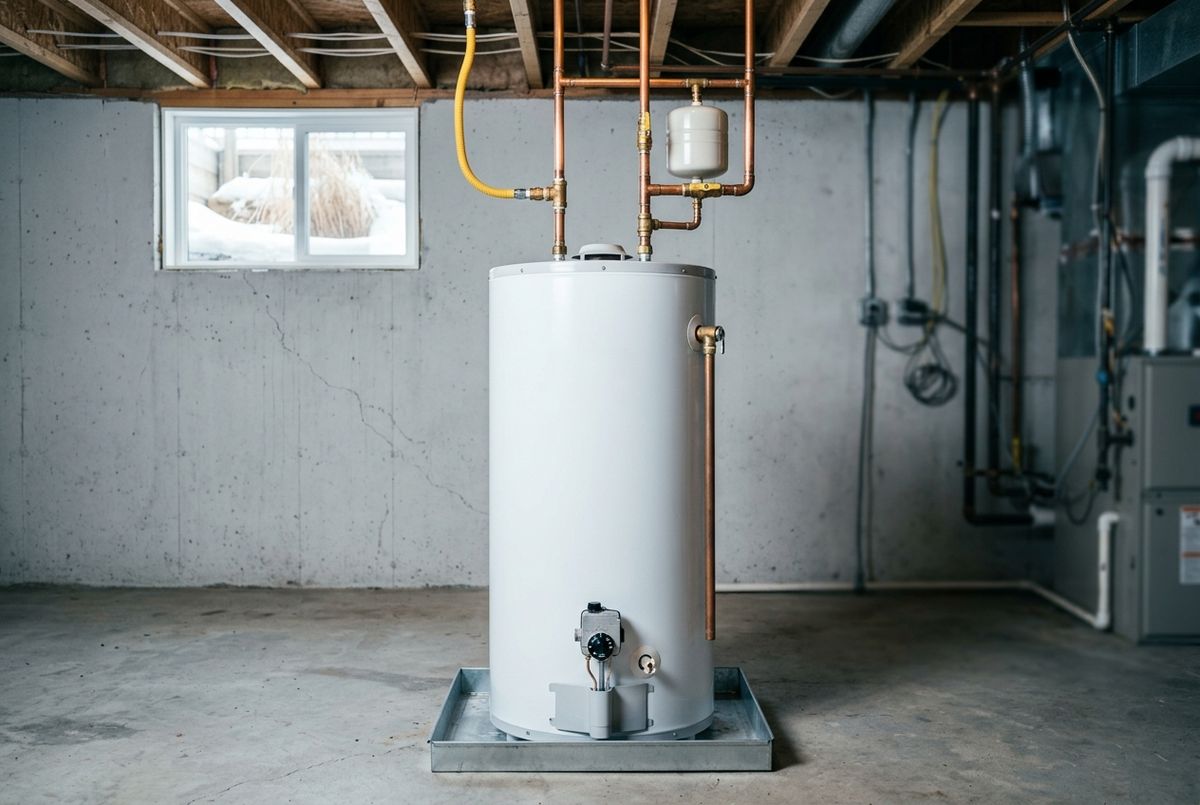
Your tank has stopped making hot water, and shortly somebody is going to ask whether you want to stay on gas or switch to electric. Worth knowing before that conversation: the two fuels break in different places, and in Calgary one costs about fifteen times as much per unit of heat as the other.
Short answer: an electric tank fails as an electrical part — almost always an element or thermostat — and the classic symptom is a short burst of hot water then cold, not no hot water at all. A gas tank fails as a combustion system: pilot, thermocouple, gas valve, or a vent that has quietly stopped drawing, which is why Alberta requires a carbon monoxide alarm in any home with a fuel-burning appliance. At published Calgary rates electricity costs $48.63 per gigajoule against natural gas at $2.12; allow for a gas tank losing heat up the flue and electric still runs roughly 15 times dearer. Repair the fuel you have.
Where each fuel actually breaks
Both tanks are the same steel vessel with the same glass lining, anode rod and relief valve. Everything below the water line is shared. What differs is the machinery putting heat in, and that's where the repair bills come from.
| Part that fails | Electric | Gas | What you notice |
|---|---|---|---|
| Upper element or thermostat | Yes | — | No hot water at all, tank not leaking |
| Lower element or thermostat | Yes | — | A short burst of hot water, then cold |
| Pilot, thermocouple, thermopile | — | Yes | Pilot won't stay lit; water cools slowly |
| Gas control valve | — | Yes | Burner won't fire on a good pilot |
| Vent, draft hood, blower | — | Yes | Often nothing — which is the problem |
| Combustion air intake blocked | — | Yes | Burner starves or short-cycles |
| Anode rod, relief valve, tank | Yes | Yes | Nothing, then water on the floor |
Sources: John Wood residential electric and gas water heater manuals.
Only that last row decides whether you're buying a repair or a replacement, and it doesn't care what fuel you burn. If yours is leaking rather than just cold, go to what to check when there's no hot water and shut the water off first.
The distinction most pages get wrong: “a bit of hot water, then cold”
A residential electric tank has two elements, top and bottom, and they do not run together. The manual is explicit: “Only one element will come on at any one time. This is known as a flip/flop system.” The upper thermostat is in charge — it heats the top portion first, then hands power down to the lower thermostat for the rest.
Source: John Wood residential electric water heater manual, quoted directly.
That handover turns a symptom into a diagnosis, because the two failures look nothing alike:
- Dead lower element. The top still heats, so you get hot water for about a third of a tank, then cold. People call this “we're running out of hot water,” assume the tank is finished, and live with it for months. It's usually one part.
- Dead upper element or thermostat. The top never reaches temperature, so power never flips down. Nothing heats — no hot water at all, from a tank that is otherwise fine.
So on an electric tank, “we keep running out of hot water” is a fault code, not a capacity complaint. Have the elements checked before anyone quotes you a bigger tank — a far larger bill, and a wasted one.
Not a DIY test. A 4,500-watt element draws about 18.75 amps at 240 volts — our arithmetic from the manual's wattage table — and that circuit isn't safe just because the thermostat has switched off.
Why a gas failure asks a second question
When an element burns out, the worst outcome is a cold shower. A gas tank has a failure mode with no electric equivalent: the burner works perfectly and the vent stops doing its job. The manual is blunt — “never operate the water heater unless it is vented to the outdoors and has adequate air supply,” and “breathing carbon monoxide can cause brain damage or death.”
Which is why Alberta legislates it. Under the Alberta Building Code, certified carbon monoxide alarms are required in every building containing a residential occupancy that also contains a fuel-burning appliance and/or an attached storage garage — including service rooms holding those appliances, and within five metres of bedrooms. The provincial guidance names “back drafting chimneys and flues” as a source, singling out tightly sealed homes with ventilation fans.
Sources: John Wood residential gas water heater manual; Alberta Safety Codes Authority — carbon monoxide alarms (January 2020). These rules are provincial, not City — confirm what applies to your building with a certified gas fitter.
That last clause is a Calgary detail whether the document says so or not: furnace, water heater and range on one house, fans pulling air out, everything sealed hard for a −30 °C week. And on a side-wall power-vented unit, the outside terminal can be blocked by drifted snow or by ice from its own exhaust. Look at it after a heavy snow.
If a CO alarm sounds, that is not a plumbing call. Get everyone outside into fresh air, then phone the emergency number on your gas bill or 911 — not us, not any plumber. Our page on what counts as a plumbing emergency puts this above every water problem on it.
What Calgary's hard water does to each
The City's 2025 data puts the Bearspaw plant between 141 and 200 mg/L of calcium carbonate and Glenmore between 181 and 274. Divide by 17.1 for grains per gallon: roughly 8.2–11.7 gpg from Bearspaw, 10.6–16.0 from Glenmore. That conversion is ours; the City publishes only mg/L and doesn't say which plant serves which neighbourhood, so ask 311.
Source: The City of Calgary — water quality and hardness data (2025).
The usual local line is that hard water wrecks water heaters, full stop. Laboratory work says something more specific. A Battelle study for the Water Quality Association ran storage tanks on artificially hardened water:
- On electric tanks the vessel survived; the element didn't. Efficiency held at the rated value “until sediment reached the bottom element and buried it, causing the bottom element to overheat.” Hard water “did not appear to impact the efficiency of electric storage water heaters or the lifetime of the tank” — and “cleaning the tank and replacing the lower element were found to restore full efficiency.”
- On gas tanks the efficiency slid from 70.4 to 67.4 per cent over the equivalent of two years — three points nobody would notice on a bill, but real.
Source: Battelle (Paul et al., 2010) for the Water Quality Association, in PNNL-22921, filed with the California Energy Commission. Read the funding line: the WQA is the water-treatment trade body — we cite it because the electric finding cuts against its interest. Tests ran near 444 mg/L, above Calgary's 141–274: accelerated lab work, not a forecast.
That changes which maintenance job matters. On an electric tank, draining sediment protects the lower element from being buried — and if you already have the “short burst then cold” symptom, the study found cleaning the tank and replacing that element restored full performance. On a gas tank the sediment sits between burner and water instead, which is the rumbling people describe. Either way the anode rod decides the tank's life, and the manual is candid that “an anode can last from one to ten years”. More on hard water here.
The fuel-switch arithmetic, shown in full
Here is where the two Calgary pages competing for this question fall down. One says gas is cheaper “due to low natural gas prices in Alberta” and gives no figure. The other compares “$0.20 per cubic meter” of gas against “$0.12 per kilowatt-hour” and concludes gas saves “a couple hundred dollars a year.” Those aren't comparable units, and the conclusion is out by roughly a factor of four.
Quoted for comparison, not endorsed: Comfort Union, Son-Rise Plumbing — both selling the installation, neither showing a calculation.
Convert both to one unit and the argument ends. Marginal price only: fixed daily charges are excluded because you pay them either way, as is the electricity local access fee — which understates the electric column.
| Natural gas | Electricity | |
|---|---|---|
| Commodity / energy | $1.124 / GJ | $0.1206 / kWh |
| Variable distribution | $1.000 / GJ | $0.015477 / kWh |
| Variable transmission | included above | $0.038996 / kWh |
| Same unit | $2.12 / GJ | $48.63 / GJ |
Sources: Direct Energy Regulated Services, September 2026; ATCO Gas South; Utilities Consumer Advocate (Rate of Last Resort, 12.06¢/kWh to 31 December 2026); ENMAX Power distribution tariff D100, 1 January 2026. Conversion ours.
Before any efficiency argument, electricity costs 22.9 times as much per gigajoule of purchased energy in Calgary. Efficiency claws some back, because a gas tank sends part of its heat up the flue and an element doesn't. It doesn't come close to closing the gap.
Natural Resources Canada puts Alberta residential water heating at 42.5 petajoules across 1,601.0 thousand households in 2021 — 26.5 GJ per household a year, or $56 a year of gas. Replace that same delivered heat with electricity, stress-tested across every efficiency assumption worth arguing about:
| Assumption | Electricity needed | Annual cost | vs $56 on gas |
|---|---|---|---|
| Gas 60% efficient, electric 100% | 4,417 kWh | $773 | 13.7× |
| Gas 60% efficient, electric 92% | 4,801 kWh | $840 | 14.9× |
| Gas 70% efficient, electric 92% | 5,601 kWh | $981 | 17.4× |
Sources: NRCan — Comprehensive Energy Use Database, Alberta residential (2021); NRCan — storage tank water heaters, which rates electric tanks by standby loss rather than an efficiency factor — hence the 100% row. The 70% is the Battelle study's measured figure. Every dollar here is our arithmetic.
Whichever row you prefer, switching a Calgary gas tank to electric costs $700 to $920 more every year, indefinitely — two energy prices an order of magnitude apart, not a close call. The same method is why the tankless payback argument doesn't survive an Alberta gas bill either.
Where this is soft. The 26.5 GJ averages every Alberta dwelling, apartments and already-electric ones included, so a gas-heated detached home sits above it — widening the gap, not narrowing it.
If you're switching fuel anyway
Neither direction is a like-for-like swap, and both cost real money before you've heated anything.
- Gas to electric needs a dedicated 240-volt circuit, a panel with room for it — in an older Calgary home that can mean a service upgrade — and an electrical permit.
- Electric to gas needs gas supply, a vent to the outdoors and combustion air. You can't pull the gas permit yourself unless you hold Alberta first- or second-class gasfitter certification — the same rule that governs any gas line work.
- Either way the old fuel gets decommissioned. An abandoned gas line is capped, an abandoned circuit made safe. Ask for these as their own quote lines.
Sources: City of Calgary — homeowner permits; Alberta Tradesecrets — plumbing is a compulsory certification trade, gasfitting a separate ticket. The homeowner permit fee was $116.50 as of August 2026, rising every January 1. We could not re-open the City fee pages the day this was written — check with 311.
Against that running cost, the install difference barely registers. For most Calgary homes the right answer when a gas tank dies is another gas tank — and when an electric tank dies it's usually a part, not a tank. See replacement costs and water heater permits.
Two things we couldn't verify. Lifespan by fuel type — Calgary pages publish contradictory numbers, one saying electric tanks last 15 to 20 years and another 10 to 15, neither sourced; we won't add a fourth. What is documented is the mechanism: the anode rod decides the tank's life, so work out how old yours really is. What an element or thermocouple costs here — no authoritative source for Calgary rates exists; see how plumbers price work.
One number you can beat us on: 26.5 GJ is a provincial average, but yours is on your own gas bill, and in summer with the furnace off nearly all of it is hot water. If the tank is leaking, start here, or if it's flooding, emergency plumbing. Back to Calgary plumbing basics →
Not sure whether yours is a part or a tank?
Send a photo of the label and tell us what you're seeing — no hot water at all, or a bit then cold. Those two point in different directions, and the difference is usually several hundred dollars. We'll tell you which, in writing, before anyone books a date.
Questions Calgary homeowners actually ask
My electric tank gives me about ten minutes of hot water and then it goes freezing. Is the tank finished?
Probably not, and this is the single most misdiagnosed thing in hot water. An electric tank has two elements, and they don't run at the same time — the manufacturer's manual calls it a “flip/flop system,” where the top one heats the upper portion first and then hands power down to the bottom one. If the lower element has failed, the top of the tank still heats perfectly. You get roughly a third of a tankful of hot water and then nothing, which feels exactly like a tank that's worn out or too small.
So before anyone sells you a bigger tank, get somebody to test both elements and both thermostats. It's a cheap check and it's frequently a single part. The version worth knowing about too: if the upper element goes, you get no hot water at all, because power never flips down to the bottom. Same tank, opposite symptom.
What would change the picture is water on the floor, or rust in the hot water. That's the tank itself, and that isn't repairable on either fuel.
My gas bill feels high. Would switching to an electric tank save me money?
No — and it isn't close, which is why it's worth being blunt about. We worked it out on this page from the published rates: at September 2026 numbers, natural gas costs about $2.12 a gigajoule delivered and electricity works out to about $48.63 a gigajoule once you convert kilowatt-hours to the same unit. That's before you allow for a gas tank losing some heat up the flue, which is the only part of the argument that runs electric's way.
Put through an average Alberta household's water heating, that's roughly $56 a year on gas against $770 to $980 on electricity. We stress-tested it three ways, including assuming electricity is 100 per cent efficient, and the gap never drops below about fourteen times. It's not an assumption you can argue your way out of; it's just what the two energies cost in Alberta.
If your gas bill is genuinely high, the thing to chase isn't the fuel — it's whether something is running that shouldn't be. Hot water is a small share of most Calgary gas bills; heating is the big one.
Is a gas water heater actually dangerous, or is that just something people say?
It's the reason there's a law about it. A gas water heater burns fuel indoors and sends the exhaust up a vent, and if that vent stops drawing properly, the combustion products don't leave. That's the failure mode an electric tank simply cannot have. Alberta's Building Code requires certified carbon monoxide alarms in every building with a residential occupancy that also has a fuel-burning appliance or an attached garage — including in the service room where the appliance lives, and within five metres of bedrooms.
The provincial guidance specifically names backdrafting chimneys and flues, and flags tightly sealed houses with ventilation fans. That's a fairly good description of a Calgary house in February with the furnace running, the range hood on and everything shut up against −30.
Practically: have a working CO alarm, look at the vent connector once a year, and don't stack storage against the base of the unit where it draws its combustion air. If an alarm ever goes off, get everyone outside first and phone the emergency number on your gas bill or 911 — not a plumber.
A plumber told me Calgary's hard water is wrecking my tank. Real, or an upsell?
Real, but more specific than the way it usually gets pitched, and the specifics matter because they change what you should actually do. Laboratory testing found that on an electric tank, hard water didn't hurt the tank's efficiency or its lifespan — what it did was let sediment build up until it buried the bottom element, which then overheated and failed. Cleaning the tank and replacing that element restored full performance. On a gas tank the sediment sits between the burner and the water instead, and measured efficiency drifted down about three percentage points over two years' worth of testing.
Worth knowing the study was funded by the water-treatment industry's trade association, which has an obvious interest in hard water sounding alarming. We'd still take it seriously, partly because its electric finding cuts against that interest. And its test water was harder than ours — roughly 444 mg/L against Calgary's 141 to 274.
So: flushing sediment is worth doing, especially on an electric tank. “Your tank is finished because of hard water” is a much bigger claim than the evidence supports. Ask what specifically has failed.
Can I change a heating element myself?
People do, and we'd rather explain the risk than pretend it's impossible. The part is cheap and widely sold. What's behind the access panel is a 240-volt circuit, and a 4,500-watt element draws somewhere around 18 or 19 amps — that circuit isn't safe just because the thermostat has clicked off. You also have to drain the tank, and getting a seized element out without damaging the tank's glass lining is where a straightforward job turns into a replacement.
If you're going ahead: kill the breaker, confirm it's actually dead with a meter rather than assuming, and check whether the work needs an electrical permit before you start. The City runs homeowner electrical permits alongside plumbing ones, and 311 will tell you what applies to your job — the rules are worth a phone call rather than a guess.
The part we'd push back on is diagnosing by replacing. If you swap an element and the symptom doesn't change, you've spent money proving the thermostat was the problem. Have it tested first.