Sump pumps in Calgary: the discharge rules, the winter problem, and whether you need one
Written for Calgary homeowners · Last reviewed August 16, 2026
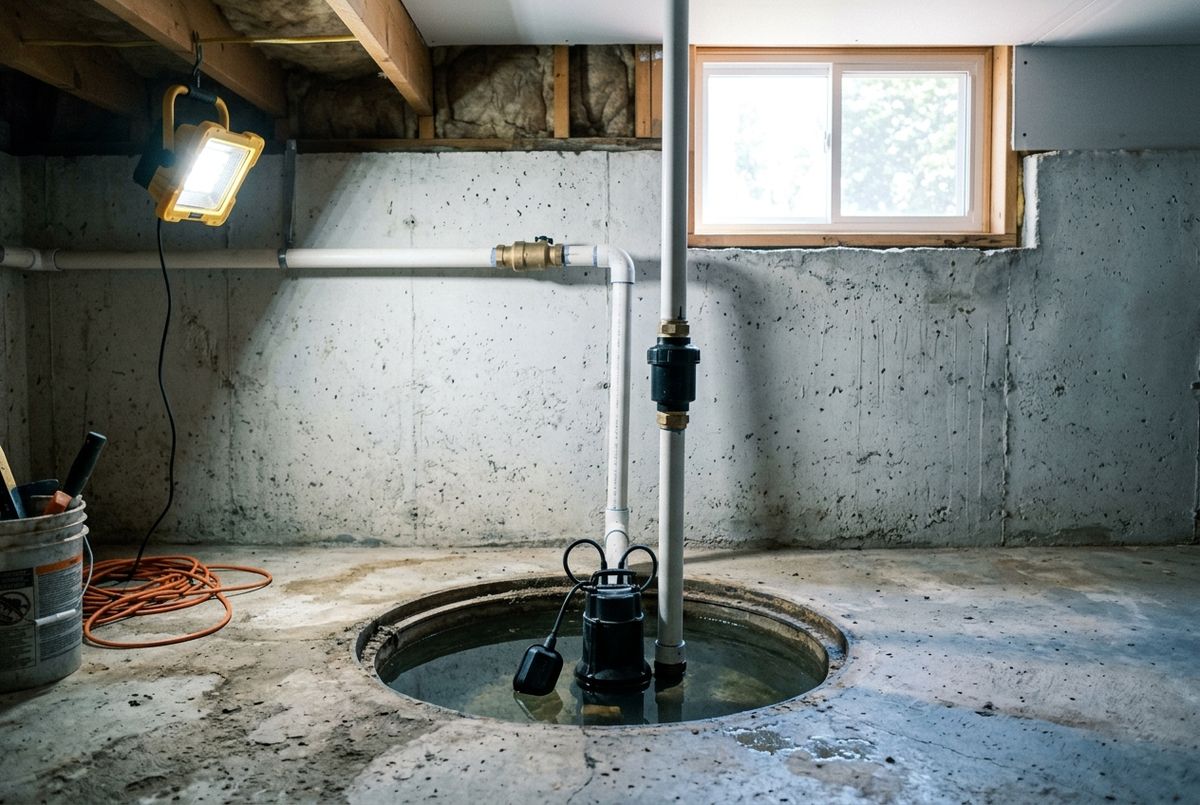
Short answer: plenty of Calgary homes don't have a sump pump and don't need one — it depends on your lot grading, your water table and whether your weeping tile actually terminates in a pit. If you do have one, the thing that catches people out isn't the pump, it's the discharge line: under the Community Standards Bylaw sump water may not drain onto neighbouring properties, lanes, sidewalks, boulevards or streets, or into a foundation drain or weeping tile. And in a Calgary February that line will try to freeze solid.
Most sump pump pages you'll find for this city are national content with "Calgary" dropped in twice, and when they reach the regulatory bit they say something like "check with the city's planning and development department." That's not advice. Here's the actual local picture.
Do you even need one?
The honest answer is that it depends on three things about your specific house, and a company that tells you every Calgary home needs a sump pump is selling, not diagnosing.
- Does your weeping tile terminate in a pit? Go look. If there's a lined pit in the basement floor with a pipe entering it below grade, your perimeter drainage was designed to be pumped, and it needs a working pump. If there's no pit at all, your home was built to drain by gravity or to shed water at the surface, and adding a pump is not automatically an upgrade.
- How does your lot grade? Calgary's problem water is far more often surface water than groundwater — snowmelt and downpour running toward the foundation because the grade has settled, the downspouts discharge two feet from the wall, or the neighbour's regrade sends it your way. Fixing grading and extending downspouts solves more Calgary wet basements than any pump does, and costs a great deal less.
- Have you actually had water? Seepage at the cove joint after a spring melt, a damp spot that reappears every April, a previous owner's telltale efflorescence on the wall. History is the best predictor you have.
If none of those apply, the money is usually better spent on grading, downspout extensions and a backwater valve, which solves a different problem entirely. If they do apply, read on, because the installation details are where Calgary gets specific.
Where the discharge water is allowed to go
This is the part nobody covers properly, and it's the part that gets you a bylaw complaint from the neighbour whose driveway keeps icing over.
Under the Community Standards Bylaw, sump pump discharge may not drain to:
- a neighbouring property
- a lane
- a sidewalk
- a boulevard
- a street
- a foundation drain or weeping tile
That last one matters more than it looks. Discharging back into your own weeping tile creates a loop — the pump pushes water out, the weeping tile brings it straight back to the pit, and the pump runs itself to death cycling the same water.
Source: The City of Calgary — basement flooding and seepage. Rules as described current at August 2026.
What that leaves, practically, is discharging onto your own property, far enough from the foundation and graded so the water keeps moving away rather than soaking back down to the pit it just left. On a narrow inner-city lot that is a genuine design constraint, not a formality, and it's worth solving on paper before anyone starts drilling through the rim joist. Getting it right means the water leaves for good, so the pump isn't recycling the same fifty litres all spring and burning out three years early.
We are deliberately not telling you whether discharging a sump pump into the sanitary sewer is permitted in Calgary. We could not verify it from a primary City source, and this is exactly the kind of detail where a confident guess on a plumbing website causes real problems. Call 311 and ask before anyone ties a sump line into a drain inside your house.
The Calgary winter problem: a discharge line that ices up
A sump pump that works beautifully in June can be useless in February, and the failure has nothing to do with the pump.
The discharge line runs outdoors. In deep cold, the small amount of water left sitting in that line after each cycle freezes. The next cycle pushes water into a partially blocked pipe, some of it freezes too, and within a few days you have a solid plug. The pump then runs against a closed pipe — it can't move water, the check valve holds it back, the water returns to the pit, and the pump either cycles continuously until the motor gives up or the pit simply overflows onto your basement floor. The homeowner hears the pump running and reasonably assumes everything is fine.
Calgary makes this worse than most places because of chinooks. Steady cold is survivable; freeze–thaw cycling is what builds the plug, because each thaw puts liquid water back into the line for the next cold snap to seize. Things that help:
- Slope the line so it drains itself. A discharge run with continuous fall leaves no standing water to freeze, so the line is empty between cycles instead of holding a plug in the making.
- Keep the outdoor run short and get the exit above the snow line. A long, flat pipe buried under a drift is the classic Calgary failure.
- Use a larger diameter outdoors than in. A wider outlet takes longer to close off with ice, which buys you days during a cold snap.
- Fit a freeze-relief or air-gap fitting. These give the pump somewhere to push water if the main line is blocked, so a frozen outlet becomes a puddle in the yard instead of a flood in the basement.
- Check it in the middle of winter, not just in spring. Walk outside during a cold snap and confirm water is actually coming out of the pipe when the pump runs.
If your basement does flood, it's your problem
The City is unambiguous about this, and it's better to know now than at 2 a.m. with a shop vac. Basement flooding is the responsibility of the homeowner. The City will only assess the flooding situation — "The City does not pump water out of basements" — and it is the homeowner's responsibility to maintain the pump.
Source: The City of Calgary — basement flooding and seepage.
One exception worth separating out: if what's coming up is sewage, from a floor drain or a basement toilet, call 311 first, because that may be a City main issue rather than yours and a plumber augering your line accomplishes nothing if the main is surcharged. That's a different problem with a different first phone call, and we walk through it on the who-owns-which-pipe page. Clean groundwater in a sump pit is yours.
Pedestal or submersible
Pedestal
Motor sits on a post above the pit, only the intake is in the water. Because the motor stays dry and accessible, it isn't sitting in the water it's pumping and you can service or swap it without fishing anything out of a full pit — which matters if you're the one doing it in April.
Downsides: it's noisier, it's visible, and it takes up headroom in a finished basement.
Submersible
The whole unit sits in the pit under a sealed lid. It's much quieter, it's out of the way, and a sealed lid keeps pit odours and humidity out of a finished basement — so it's the usual choice where the pit is in living space.
Downsides: the motor lives in the water, seals eventually fail, and replacement means pulling a wet pump out of a pit. Compare the manufacturer's warranty on the two rather than trusting anyone's rule of thumb about which lasts longer.
Either way, the specification that actually matters is capacity against your real inflow, and a check valve on the discharge so water doesn't fall back into the pit and make the pump cycle twice for the same litre. Ask whoever quotes you what capacity they're proposing and why — if the answer is "the standard one," keep asking.
Battery backup: the boring feature that earns its money once
A sump pump needs power, and the weather that fills your pit is the same weather that takes the power out. A heavy spring melt with a wet snow on top, or a summer thunderstorm that dumps in a single afternoon with wind behind it — those arrive with outages far more often than anyone plans for. A pump with no power is a hole in your floor.
A battery backup means the pit keeps getting emptied through an outage, so a power cut during the exact hour you need the pump doesn't become a flooded basement and an insurance claim. A backup also covers the other common failure — the primary pump dying mid-season — if it's plumbed as a genuine second pump rather than just a second power source. Ask which you're being quoted.
Test the backup on the same schedule as the pump. A battery that's been sitting for four years is not a backup, it's a decoration.
Testing and replacement
The City's guidance is to replace sump pumps every 10 years, or sooner.
Source: The City of Calgary — climate ready measures, drainage and water management.
Test it once a year, and do it in March, before the melt, not in July when it doesn't matter.
- Lift the lid and look in the pit. Gravel, silt and construction debris in the bottom will chew an impeller. Scoop it out.
- Pour water in until the float lifts. A bucket or two. The pump should start on its own, not after you jiggle the float.
- Confirm it actually shuts off. A pump that runs on after the pit empties is a float problem and it will burn out.
- Go outside and check the discharge. Water should be leaving the pipe and running away from the house, not pooling against the foundation and coming back.
- Test the backup separately. Unplug the primary and repeat. If nothing happens, you found out in March instead of at midnight in June.
- Note the install date on the pump body with a marker. In eight years you'll be glad it's written down.
A sump pump is not a backwater valve, and one is not a substitute for the other
This confusion is common and it's expensive, because people install one device and believe they're protected against both problems. They solve different failures.
| Sump pump | Backwater valve | |
|---|---|---|
| Problem it solves | Groundwater and seepage collecting under or beside your foundation | Sewage flowing backwards from the City main into your basement |
| Where the water comes from | Outside, through the ground and weeping tile | The sanitary sewer, when the main surcharges |
| What it does | Actively pumps clean water out of a pit | Passively closes a flap so nothing comes back up the line |
| Needs power? | Yes — hence battery backup | No |
| Permit | Confirm with 311 for your specific job | Yes — a plumbing permit is required to install a back-flow prevention device |
| Maintenance | Annual test, replace around 10 years | Open the access cap and clear debris off the flap periodically |
Permit requirement source: The City of Calgary — climate ready measures.
A house that gets spring seepage through the floor and a house that gets sewage up the floor drain during a summer storm need different fixes. Some houses need both. If yours has a legal secondary suite, the backwater rules get more complicated again — see backwater valves and secondary suites. And as of August 2026 there is no City of Calgary rebate for either device, which we cover on the rebate page.
What it costs, honestly
We're not going to publish a sump pump price list, because there isn't an authoritative public source for Calgary installation costs and any number we invented would be a guess dressed up as data. What we can tell you is what moves the price: whether a pit already exists or concrete has to be broken and a new one formed, how far the discharge has to run to reach a legal outlet, whether an electrical circuit is available at the pit, pedestal versus submersible, and whether you're adding a battery backup or a genuine second pump.
Labour rates published by Calgary plumbing companies about themselves sit in the $85–$150 an hour range for regular hours, which is a starting point rather than a benchmark — our page on what plumbers charge explains why no reliable published figure exists and how to compare two quotes fairly. Get the scope in writing, including where the discharge terminates and who restores the concrete.
Not sure whether you need a pump, a grading fix, or a backwater valve?
Describe what you're seeing and when it happens — spring melt, heavy rain, or year-round damp — and we'll tell you which of the three it points at before anyone quotes you hardware. If the answer is downspout extensions and a load of topsoil, we'll say that, and you can keep the money for something else.
Questions Calgary homeowners actually ask
Do I actually need a sump pump in Calgary?
Go down and look at your basement floor first. If there's a lined pit with a pipe entering it from below grade, your weeping tile was designed to be pumped and you need a working pump in it. If there's no pit anywhere, your house was built to drain by gravity or shed water at the surface, and plenty of Calgary homes in that category have never had a drop in the basement.
The bigger truth is that most wet Calgary basements are a surface water problem, not a groundwater problem — settled grading against the foundation and downspouts dumping two feet from the wall. Fixing those solves more basements than any pump, and it's a fraction of the cost. Anyone who tells you every home in this city needs a sump pump is quoting, not diagnosing.
Where can I run the discharge pipe? My neighbour is complaining.
They may well have a point. Under the Community Standards Bylaw, sump discharge can't drain onto a neighbouring property, a lane, a sidewalk, a boulevard or a street, and it can't go back into a foundation drain or weeping tile. On a narrow inner-city lot that doesn't leave a lot of options, which is exactly why so many discharge lines end up pointed somewhere they shouldn't be.
What you're aiming for is a spot on your own property, well away from the foundation, graded so the water keeps travelling instead of soaking down to the pit it just came from. And the weeping tile prohibition isn't just red tape — pump into your own weeping tile and you've built a loop that runs the same water in circles until the motor dies.
Can I pump the sump water into a drain inside the house?
We're not going to answer that one, and we'd rather say why than guess. Whether sump discharge may go to the sanitary sewer in Calgary is something we could not confirm from a primary City source, and it's the sort of detail where a confident wrong answer on a plumbing website causes real trouble for the homeowner, not for the website.
Phone 311 and ask before anyone ties a sump line into an interior drain. It's a two-minute call and it's the only version of this answer worth having.
My pump runs but the basement still got wet in February. What happened?
Almost certainly the discharge line froze. The pipe runs outdoors, a little water sits in it after each cycle, and in a cold snap that freezes. The next cycle adds more, and within a couple of days there's a solid plug. After that the pump runs, the water can't get out, it drains back into the pit, and the pump keeps cycling until it burns out or the pit overflows. Meanwhile you can hear it running and assume everything's under control.
Chinooks make it worse here than in a place with steady cold, because each thaw refills the line with liquid water for the next freeze to seize. Slope the line so it drains itself, keep the outdoor run short and above the snow, use a bigger diameter outside than in, and fit a freeze-relief fitting so a blocked outlet dumps in the yard rather than in your basement. Then actually go outside during a cold snap and check water is coming out.
Will the City pump out my basement if it floods?
No. The City is blunt about it: basement flooding is the homeowner's responsibility, The City will only assess the situation, and "The City does not pump water out of basements." Maintaining the pump is on you too.
The one thing worth separating out is what kind of water it is. Clean groundwater in a pit is entirely your problem. Sewage coming up a floor drain is a different call — ring 311 first, because if the City main is surcharged then half your block is backing up and paying a plumber to auger your line achieves nothing. Take photos before you clean anything up either way.
I have a backwater valve. Do I still need a sump pump?
They're not interchangeable, and this mix-up costs people basements. A backwater valve is a passive flap on your sewer line that stops sewage flowing back into the house when the City main surcharges. A sump pump actively lifts clean groundwater out of a pit before it reaches your floor. One does nothing about the other's problem.
If your basement gets damp along the cove joint every spring melt, that's a groundwater and grading issue and a backwater valve won't touch it. If sewage comes up the floor drain during a summer downpour, a sump pump won't touch that either. Some Calgary houses genuinely need both. Note that installing a back-flow prevention device requires a plumbing permit, and as of August 2026 there's no City rebate for either device.