No hot water in Calgary: what to check, what to shut off, and when to call
Written for Calgary homeowners · Last reviewed September 19, 2026
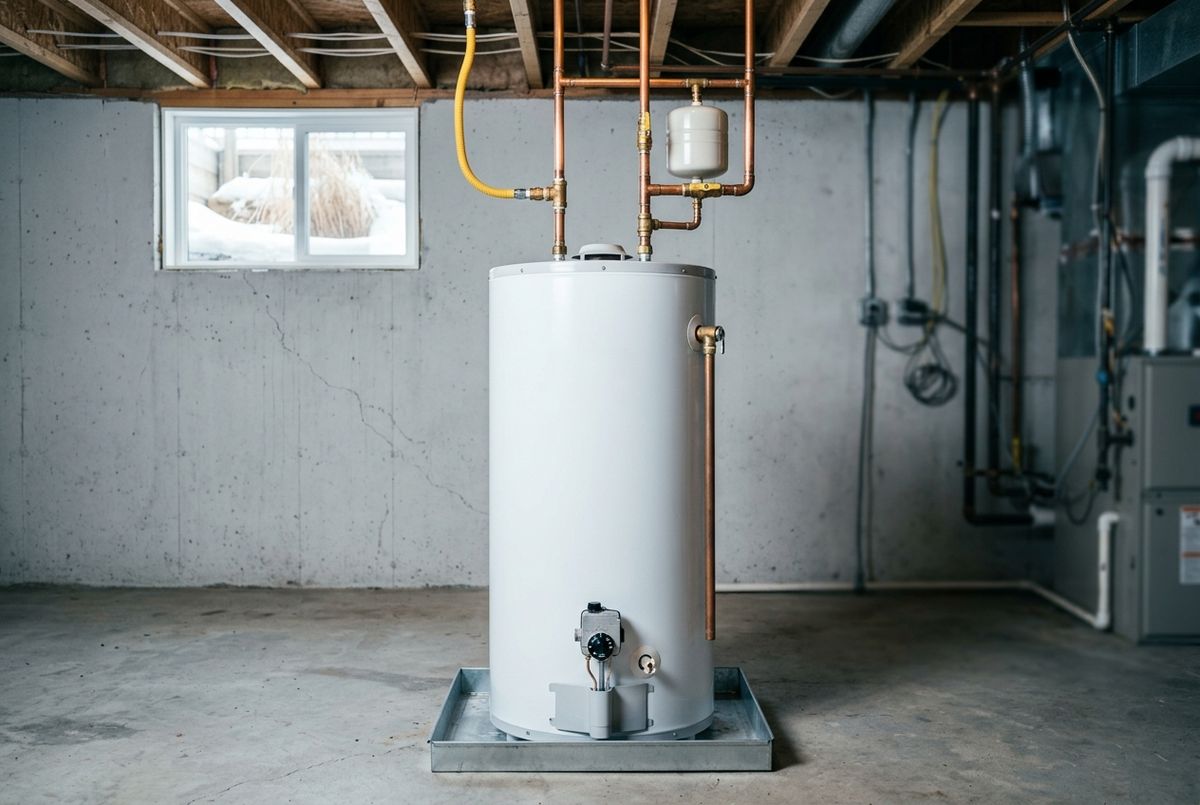
Cold shower, and the tank in the basement is either silent or making a noise it didn't used to make. Two things decide what happens next: whether anything is leaking, and whether you smell gas. Deal with those first, then work down the checklist. Some of what follows costs nothing and takes five minutes — a tripped breaker, a dial left on PILOT, a pilot that blew out in a windstorm — and we'd rather you found it yourself than paid someone to find it for you.
If you smell gas, stop reading and get out
Don't look for the source. Don't relight the pilot. Don't flip switches, unplug anything or use your phone inside the house. Get everyone and any pets outside, leave the door open behind you, and from outside call ATCO Gas's 24-hour emergency line (it's on your gas bill) or 911. A plumber is the wrong first call. Nobody will think less of you for a false alarm.
Already know you need someone?
Describe what it's doing over the phone and we'll tell you whether it's a part, a tank, or something you can fix yourself in ten minutes — before anyone gets in a van. Same-day where we can, and an honest answer about our actual arrival window if we can't. [LICENCE / WCB / INSURANCE INFO]
Is it leaking? Do this first
A tank that isn't heating is an inconvenience. A tank that's leaking is a clock. Check the floor around the base before anything else.
Not sure it's a leak? Dry the floor, lay down paper towel, check again in two hours. Cold Calgary supply water hitting a tank in a humid basement makes real condensation, and so does a big hot-water draw. Wet paper means a leak.
The shut-off sequence
- Shut the water off at the interior main. In most Calgary homes it's in the basement on the wall facing the street, often in sight of the water heater — a round handle or a quarter-turn lever, sometimes with the meter beside it. If your tank has its own cold-water shut-off on the inlet pipe at the top, closing that isolates the tank alone and leaves the rest of the house with water, which is the better outcome if it works.
- Turn the gas control to OFF, or kill the breaker. On a gas tank there's a dial or switch on the control valve near the floor — turn it to OFF, not to PILOT. On an electric tank, switch off the dedicated breaker at the panel. This matters because a tank that keeps heating while it empties can damage the elements or the burner assembly and turn a replacement into a bigger one.
- Get the water moving away from anything expensive. Towels, a wet-vac if you have one, and lift anything off the floor nearby.
- Then call. With the water and fuel off, you've stopped the damage and bought yourself the ability to make a decision rather than a panic purchase.
Do not touch the curb stop outside
The valve under the little metal cap near your sidewalk is the water service valve. It sits close to the property line — not always on The City's side of it — but The City of Calgary owns it either way, and says so plainly: service valves "are owned and operated by The City of Calgary," and if one needs turning, you book a service call and they come and turn it. The valve that's actually yours is the main shut-off inside the house, so use that one. People pop the cap with a screwdriver, damage the valve or the operating rod, and add a City repair to the bill they already had.
Sources: The City of Calgary — Water service lines in Calgary and Service valves in Calgary. More on who owns which pipe.
The five-minute checklist before you call anyone
Nothing here involves tools, gas fittings or opening anything sealed. If one of these is your answer, you've just saved yourself a service call.
- Work out whether you're on gas or electric. A metal flue pipe going up from the top of the tank, and a small access panel near the floor, means gas. No flue and a heavy cable running into the side means electric. Everything after this depends on which one you have.
- Electric: check the breaker. A tripped water-heater breaker can look "on" — push it firmly to OFF, then back to ON. Also check for a small red reset button behind the upper access panel cover on the tank; that's the high-limit switch, and it trips. If either one trips again straight away, stop and call. Something is drawing more than it should.
- Gas: is the pilot lit? Look through the little window at the base or pop the outer access cover. No flame means no heat, and the relighting instructions are printed on a label on the tank. Follow that label, not a video for a different model.
- Gas: check the control dial isn't on PILOT or VACATION. It happens more than you'd think, usually after somebody's been away, or after a furnace service where things got switched around. Turn it to ON and give it 30–45 minutes.
- Check the gas supply valve on the pipe feeding the tank. Handle in line with the pipe means open; across the pipe means closed. Don't force anything — if it doesn't move easily, leave it.
- Check the thermostat setting. Somebody may have turned it down. Most tanks run around 49–60 °C; lower saves gas but you run out faster, which reads to the house as "no hot water."
- Ask whether it's really no hot water, or not enough. Scalding-then-cold in three minutes is a different fault from stone cold at the tap. Not enough usually means a broken dip tube, a failed lower element, or a decade of sediment eating your tank volume — and in Calgary, sediment is the usual suspect.
If you're mid-cold-snap and you also have no heat, check the furnace before you assume the tank. A furnace and a water heater on the same gas line can go out together for the same reason, and heat is the more urgent of the two. Related: frozen and burst pipes.
What's actually broken: narrowing it down
Knowing the likely culprit before you call is the difference between accepting a quote and understanding it.
| What you're seeing | Most likely cause | Repair or replace |
|---|---|---|
| Pilot lights, then goes out as soon as you release the button | Thermocouple or thermopile — the safety sensor that tells the gas valve a flame exists | Repair. Common part, straightforward job. |
| Pilot lights and holds, but the main burner never fires | Gas control valve, or a thermostat fault inside it | Repair, but it's the pricier one — on an old tank, weigh it against replacement. |
| Pilot won't light at all, no gas smell | No gas to the appliance, a blocked pilot orifice, or a tripped safety on the burner assembly | Diagnose before assuming. Don't keep striking it. |
| Electric tank stone cold, breaker holding | Failed upper element or thermostat, or a tripped high-limit reset | Repair. Elements are inexpensive parts. |
| Electric tank: hot for two minutes, then cold | Failed lower element — upper is doing all the work | Repair. Usually both elements get done together. |
| Rusty water from hot taps only | Anode rod consumed, tank interior corroding | Replace. This is the tank giving notice. |
| Water at the base of the shell, rust streaks from a seam | The steel vessel has rusted through | Replace. There is no repair for a leaking tank and anyone offering one is selling you a delay. |
One Calgary-specific note running through all of this: our water is hard — the City's 2025 figures put Bearspaw around 141–200 mg/L and Glenmore around 181–274 mg/L of calcium carbonate, which converts at 17.1 mg/L per grain to roughly 8–12 and 11–16 grains per gallon respectively. That scale coats burner surfaces and elements, which makes them run hotter and fail sooner than the same part would in a soft-water city. It's why "the part failed early" is a normal outcome here rather than a sign you were sold a lemon, and why people replacing a tank often ask about putting a softener in front of the new one.
Source: The City of Calgary — Water quality and water hardness data. Conversion to gpg is ours. Full hardness breakdown →
Tonight or tomorrow? The honest version
We'd rather tell you to wait and earn the call in the morning than take a night booking you didn't need.
Call now
Water is actively spreading, or the tank sits above a finished basement or on carpet. Damage compounds by the hour and the restoration bill is usually the bigger one — a midnight premium beats replacing a ceiling.
Call now
It's deep winter, the house is also losing heat, or the property is about to sit empty. In a Calgary cold snap a stalled heating appliance becomes a frozen-pipe problem overnight.
Wait until morning
Nothing is leaking and you just have cold water. Boil a kettle, shower somewhere else, book at day rates. You'll pay less, get a proper diagnostic instead of a fast fix, and have time for a second quote if it's a replacement.
The cost gap is real and worth naming. Plumbing companies around Calgary publish independent rates of roughly $85–$120 an hour, company rates of $95–$150, and emergency or after-hours rates of $150–$250. Those are self-reported figures from a competitor's own page, not an authoritative source — and there isn't one. No public body publishes plumber rates for this city, so treat every number you see online, including these, as a planning estimate rather than a quote.
Rates as self-reported by Mr. Mike's Plumbing (updated December 2025). See our full breakdown of Calgary plumbing costs.
If it turns out to be a replacement
Ask for the quote itemised: the tank, the labour, the permit if one is needed, and hauling the old unit away. That's how you tell whether two quotes are actually comparable. Our page on replacing a hot water tank in Calgary covers what each of those lines should look like and where the published prices come from.
On permits — as of September 2026, The City requires a plumbing permit when "a plumbing system is constructed, extended or altered," and the things that pull a water heater into that are changes to the gas line, to the venting, or to the type of heater. A like-for-like tank going back into the same spot on the same flue typically touches none of the three; a tank-to-tankless conversion touches all three, so the permit question there is settled before you ask it. Gas is stricter again: homeowners "cannot take out a gas permit" on their own house unless they hold first- or second-class gasfitter certification, so on a gas tank a licensed contractor pulls it. The detail is on our water heater permit page.
Source: The City of Calgary — Homeowner electrical and plumbing permits.
And before you sign anything, it's worth knowing whether the tank was near the end anyway — how to read its real age off the serial number is here. Which fuel you have also changes what fails and what the diagnosis costs: gas and electric tanks break in different ways. And if a dead tank has you tempted by tankless, read the running-cost arithmetic first — worked from published rates, the annual saving is far smaller than the pitch suggests. If you want the wider picture on plumbing in this city, start at our main Calgary plumbing guide.
Questions Calgary homeowners actually ask
My pilot light keeps going out. Can I just keep relighting it?
You can relight it, and it's worth doing once to see what happens. If it lights and stays lit, something knocked it out — a draft, a gust down the vent in a windstorm, a bit of dust on the sensor. That happens, especially in the shoulder seasons when the wind is doing strange things around Calgary rooflines.
If it goes out again within a day or two, stop relighting it and get it looked at. A pilot that won't hold is nearly always a thermocouple or thermopile that has stopped generating enough signal to convince the gas valve the flame is really there. That's a safety interlock doing its job, and it's a cheap part with a straightforward fix. Repeatedly forcing a flame past a failing safety device is the one part of this job we'd genuinely tell you not to do yourself.
There's water under my tank. How do I know if it's actually leaking?
Dry the floor completely, put down a sheet of paper towel or newspaper, and come back in a couple of hours. If it's damp again, you have a leak. If it stays dry, you were probably looking at condensation — which is common on a cold Calgary morning when very cold incoming water hits a tank in a humid basement, and also common right after a big hot water draw.
While it's dry, look at where the water is showing up. Water at the base of the shell, or rust staining running down from a seam, usually means the steel tank has rusted through and there's no repair for that. Water coming from a fitting at the top, from the drain valve at the bottom, or from the discharge pipe off the relief valve is a different story — those are parts, and parts can be replaced.
Should I shut off the water at the curb if my tank is flooding?
No — and this one matters. That valve out by the sidewalk is the water service valve, usually called the curb stop, and The City of Calgary owns and operates it. If it genuinely needs turning, the City books a service call and sends someone. People pry the little cap off with a screwdriver, damage the valve or the rod, and end up with a City repair bill on top of the plumbing bill they already had.
Use the shut-off inside your house. In most Calgary homes it's in the basement on the wall facing the street, often within sight of the water heater, and it'll be a round handle or a lever. Find it today, before you need it, and make sure whoever else lives there knows where it is too. That thirty seconds of homework is the difference between a wet floor and a flooded basement.
Is this worth paying after-hours rates for, or can it wait until morning?
If nothing is leaking, it can almost always wait. No hot water is miserable, not dangerous — boil a kettle, shower at the gym, call in the morning at day rates. Plumbing companies around Calgary publish emergency and after-hours rates in the $150–$250 an hour range against roughly $85–$150 for regular hours, so a night call on a cold tank is a real premium to pay for a warm shower a few hours earlier.
If water is actively spreading, that's a different calculation, and it's usually worth the call — water damage compounds by the hour, and the drying and restoration bill dwarfs the plumbing one. Same if you're on the way out of town, or if the tank sits above a finished basement. And in a deep cold snap, if your house is losing heat as well as hot water, don't sit on it: that's how a plumbing problem turns into a frozen pipe problem.
I smell gas near the water heater. What do I do?
Leave. Don't troubleshoot it, don't try to find the source, don't relight anything. Don't flip light switches, unplug things, or use your phone inside — take everyone and any pets outside first, and leave the door open behind you.
From outside, call ATCO Gas's 24-hour emergency line, which is on your gas bill and on their website, or call 911. They will come out. This is not a call you should feel awkward about making — they would far rather attend a false alarm than the alternative, and a plumber is the wrong first phone call here regardless of how confident you are that it's minor.
My tank is 14 years old and it's just died. Repair or replace?
At fourteen, replace, unless the failed part is genuinely trivial and you need a few weeks to get organised. Calgary's water is hard enough that most tanks here are living on borrowed time past twelve, and putting a new gas valve on a vessel whose lining is already cracked is spending real money on a delay.
The thing to weigh isn't just the repair bill against the replacement bill — it's what a failure costs when it happens on its own schedule. A planned replacement in September means you pick the model, get two quotes, and pay day rates. The same tank going in the middle of January means whatever is on the truck, at emergency rates, possibly with a wet floor. We went through the whole repair-versus-replace call here.