Replacing a hot water tank in Calgary: what it costs and what actually drives the price
Written for Calgary homeowners · Last reviewed August 24, 2026
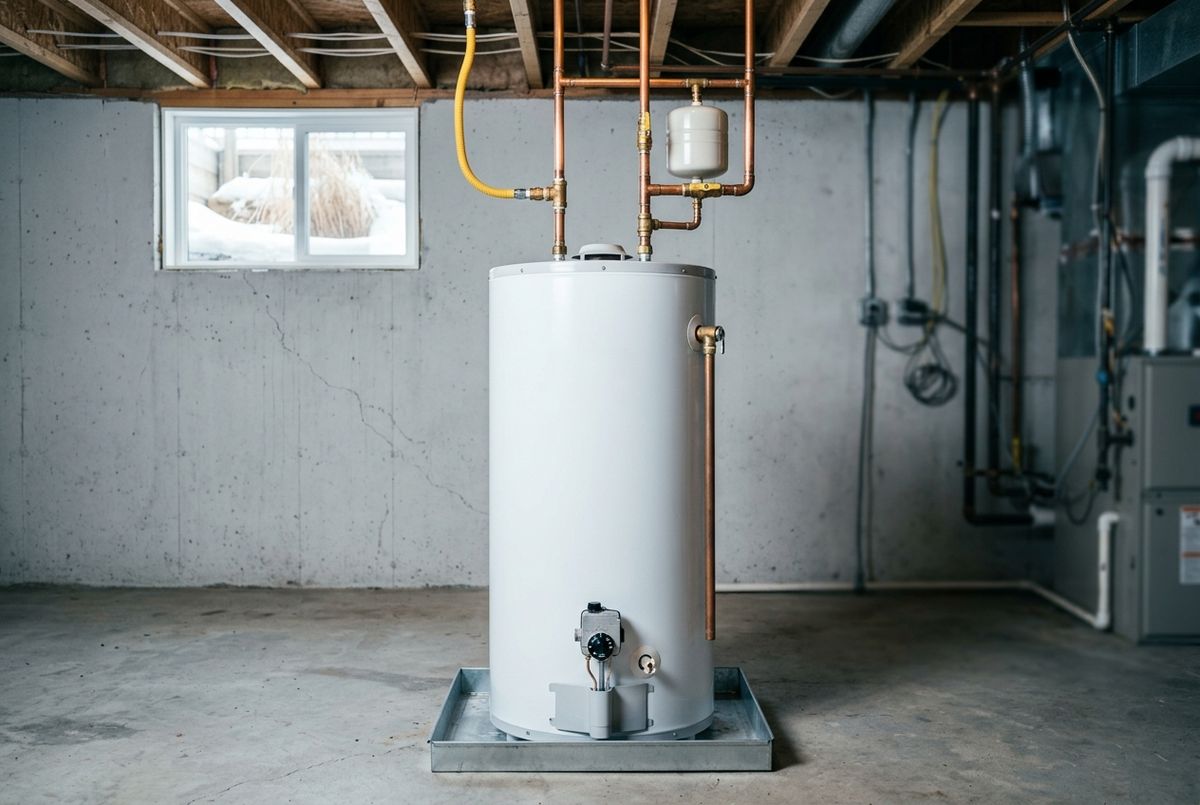
Short answer: Calgary companies publish installed prices for a standard gas tank replacement in the range of roughly $1,800–$3,500, with electric at the lower end and power-vent gas at the upper end. Treat that as a planning range and nothing more — every published figure in this city is a company quoting itself, there is no independent source, and the thing that actually decides your number is the venting, not the tank.
You've either got water on the floor or a tank with a date sticker you've finally gone and read, and you want a number before you start phoning people. The frustrating part is that the prices online are all published by the companies selling the work, and they vary by more than a thousand dollars for what sounds like the same job. Here's where those numbers come from, what genuinely moves them on a Calgary house, and what to ask so three quotes become comparable instead of confusing.
Where the published numbers come from
Start with the honest disclosure, because it changes how you read everything else. There is no authoritative public source for what a hot water tank costs to replace in Calgary. No City department publishes it, no trade association publishes it, no consumer body audits it. Every dollar figure you will find, including the range at the top of this page, traces back to a plumbing or HVAC company's own website. That doesn't make them useless — where independent companies land in the same territory, the territory is probably about right. It does mean you should know whose numbers you're looking at.
| What's being replaced | Range published | Whose number |
|---|---|---|
| Overall "normal range", installed | $1,800–$3,500 | Comfort Union |
| Atmospheric vent, gas | $2,400–$3,200 | Comfort Union |
| Power vent, gas | $3,000–$3,500 | Comfort Union |
| Electric | $1,800–$2,800 | Comfort Union |
| Venting modifications, on top | $300–$800 | Comfort Union |
| Gas line work, on top | $260–$1,500 | Comfort Union |
| Old tank removal and disposal | $50–$150 | Comfort Union |
| Installed replacement, "starts at" | from $2,000 | The Heating Ninja |
Sources: Comfort Union — hot water tank installation cost and The Heating Ninja — hot water tank installation and costs in Calgary. Both are companies selling the work; neither cites an independent source.
One figure on those pages is checkable, and it's wrong in the direction you'd expect. Permit fees are published as "generally $100 to $300." The City of Calgary's actual homeowner plumbing permit is $116.50 — $112 plus a $4.50 Safety Codes Council fee — and a contractor trade permit has the same $116.50 as its floor. When a quote leans on permit cost to explain a big number, that's the number to hold it against.
Sources: The City of Calgary — Homeowner electrical and plumbing permits; City of Calgary building and trade permit fee schedule. Current as of August 2026; City fees increase annually on January 1.
The venting decides your price, not the tank
Two identical 50-gallon tanks can be a $2,400 job and a $3,600 job on the same street. The difference is almost never the box. It's how the exhaust leaves the building, which means you can work out roughly which conversation you're in before anyone comes over.
Atmospheric — the cheap case
A plain metal flue pipe rising off the tank into a chimney, no fan. If yours is atmospheric and the flue is still sound and correctly sized, a like-for-like swap is the simplest version of this job — so expect a quote near the bottom of the range, and push back on one near the top.
Power vent — the expensive case
A blower on top of the tank pushing exhaust out through a plastic pipe in a side wall. The unit itself costs more and it needs an electrical outlet beside it, so it lands higher — but it frees you from the chimney entirely, which is what makes it the answer when the chimney is the problem.
Switching between them — the surprise
Going from atmospheric to power vent adds a wall penetration, new venting and power. That's the quote that comes back a thousand dollars over what your neighbour paid, and it isn't padding — it's a different job, so ask for it to be shown as its own line rather than folded into the tank price.
The same wall penetration and power supply turn up again if you're considering tankless instead — what that conversion involves in a Calgary house. The switch happens more here than most people expect, and usually for one reason: the furnace went first. Plenty of Calgary homes built before the 1990s share a masonry chimney between the furnace and the water heater. When that furnace is replaced with a modern high-efficiency unit venting out a side wall, the tank is left alone on a flue sized for two. Somebody eventually has to deal with that, and it is frequently the person replacing the water heater — often without being warned it was coming.
If your furnace was replaced in the last few years and your tank still vents into the chimney, ask specifically about the flue when you get quotes. It's the most common way a Calgary tank replacement turns out bigger than budgeted, and far better found at the quote stage than on installation day.
What else moves the number
- Where the tank actually sits. Beside the stairs on bare concrete is a straightforward carry. Wedged behind a finished wall, or down a tight turn, means more time and sometimes drywall — so answer the access question honestly on the phone rather than letting it surface on the invoice.
- Whether the gas line is right for the new unit. A larger burner draws more gas, and the line has to be assessed against everything else on the meter — furnace, range, fireplace, garage heater — not just the tank alone. If it needs resizing, that's separate work by a licensed gasfitter. How gas permits work in Calgary →
- The condition of what it connects to. Seized shut-off valves, corroded unions and old flexible connectors get replaced while the system is drained, because doing it later means draining it again. Small money at the time, annoying money afterwards.
- When you're calling. Demand isn't flat. A tank that fails during a cold snap competes with every other emergency in the city that week, and you're choosing from whoever can come rather than whoever quoted best. How after-hours plumbing pricing works →
- Removal and disposal of the old tank. Usually a small line, occasionally omitted from a quote entirely. Check that it's in there, because a drained tank left in your utility room is still your problem.
We can't point you to a public benchmark for how long the job should take — nobody publishes one for Calgary, and any confident number you read online is somebody's marketing. What you can do is ask each shop what they've scheduled for it. Three answers of "most of a morning" and one of "an hour" tells you something useful.
Does it need a permit?
Often, but not for the reason most pages give. The City of Calgary states that a plumbing permit is not required to replace existing fixtures, and on the water side a tank going back into the same place on the same connections is a fixture replacement. What puts a permit in play is usually the gas: the connection, the venting, or a change in the type of heater.
Source: The City of Calgary — Homeowner electrical and plumbing permits (current as of August 2026)
And the gas is the part you can't do yourself regardless of how handy you are. A Calgary homeowner cannot pull a gas permit unless they personally hold Alberta first- or second-class gasfitter certification, live at the address, and apply in person with proof. That's why the DIY route collapses on a gas tank even though Alberta's owner exemption lets you do your own plumbing — gasfitting is a separate certification from plumbing, and one doesn't cover the other. The full permit breakdown, including the four things that flip the answer to yes →
Why Calgary tanks come out earlier than the box promised
This is measurable rather than sales talk. The City publishes hardness figures for both treatment plants: Bearspaw runs roughly 141–200 mg/L of calcium carbonate through the year and Glenmore runs roughly 181–274 mg/L. The City doesn't publish grains per gallon, so we converted it — divide by 17.1 and that's about 8–12 gpg on the Bearspaw side and 10.6–16.0 on the Glenmore side, which is "hard" to "very hard."
Source: The City of Calgary — Water quality and hardness data (2025 figures). The City does not publish which plant serves which neighbourhood — ask 311 if you want to know yours.
That mineral settles out in the bottom of the tank, where it insulates the burner from the water it's trying to heat and makes the whole thing work harder for the same shower. It's the main reason Calgary tanks tend to underperform the lifespan printed on the label, and it's worth knowing before you buy: the premium tank isn't buying you the warranty years unless the water it holds is being managed. What Calgary's hard water actually does to plumbing → · How long tanks really last here →
Before you replace, make sure you need to
Replacement gets recommended faster than it needs to be, and a tank is an expensive thing to buy for a small fault. No hot water at all is very often a pilot, thermocouple or gas valve — or on an electric tank an element or thermostat — all repairs, and the failure modes split cleanly by fuel. Water near the base can be condensation, a discharge from the temperature and pressure valve, or a fitting rather than a rusted-through shell. The signs that genuinely mean replacement are rusty hot water at the taps, heavy rumbling from sediment, and moisture coming from the tank body itself. If you're not sure which you've got, work through the no-hot-water checks first — five minutes that occasionally saves a couple of thousand dollars. And if someone has offered you tankless instead, check the running-cost arithmetic before you pay the premium.
How to make three quotes comparable
- Photograph your setup before you call. The top of the tank, the vent pipe, the gas line and the rating plate. Sending the same four photos to everyone means you're getting quotes on the same job instead of three guesses.
- Ask each of them what vent type they're quoting. If one has quoted a power vent and the others haven't, you've found your price gap immediately — and you can then ask the cheaper ones what they're planning to do about the chimney.
- Get the tank, labour, venting, disposal and permit as separate lines. A single number is fine to sign but not to compare. Separate lines show you which shop is expensive on labour and which is expensive on the unit.
- Ask who warranties what, and for how long. The tank warranty comes from the manufacturer. The labour warranty comes from the shop, and it's the one that varies. Get both in writing.
- Ask what happens if they find something once they start. Corroded valves, a failed flue, an undersized line. You want to know whether that's a phone call to you or a line added to the invoice — before they start.
None of that requires you to know anything about plumbing. It just makes it hard to hide a difference in scope inside a difference in price. More on how Calgary plumbers price work, and the service call fee most pages leave out → · Back to Calgary plumbing basics →
Want a straight number on your tank?
Send photos of the tank, the vent and the gas line and we'll tell you which of the three cases above you're in and what it should cost — in writing, before anyone books a date. If it turns out to be a repair rather than a replacement, we'll say that too.
Questions Calgary homeowners actually ask
Can I buy the tank myself at a big-box store and just pay someone to install it?
You can ask, but a lot of Calgary shops will say no, and it's worth understanding why before you assume you're being upsold. When a contractor supplies the tank, they carry the warranty conversation — if it fails in year three, that's their problem to chase with the manufacturer. When you supply it, that chain breaks, and most of them would rather not be halfway inside it.
The other half is the labour warranty. If your tank leaks and nobody can say whether it was the unit or the install, you end up with two parties pointing at each other and you in the middle. Ask up front: who warranties the tank, who warranties the work, and for how long. If the answer to supply-your-own is yes, get that split in writing before anyone books a date.
How do I know whether I need a power vent or the ordinary kind?
Go and look at the top of your current tank. If a plain metal pipe rises off it at an angle and disappears into a chimney or a bigger shared flue, that's an atmospheric tank — it vents on the fact that hot gas rises, with no fan. If there's a plastic pipe running out through a side wall and a small blower on top, that's a power vent.
The usual reason a Calgary house ends up switching is the chimney. Older inner-city homes often share a masonry flue between the furnace and the tank, and once the furnace gets replaced with a modern high-efficiency one that vents out the side wall, the tank is left alone on a flue that's now oversized for it. That's the moment the conversation changes from a swap to a venting job, and it's the single biggest reason two houses on the same street get very different quotes.
Do I have to put back the same size I've got now?
No, but resist the urge to jump up a size just because you once ran out of hot water. Think about what actually changed. Two kids who now shower back to back is a real reason. One bad morning three winters ago is not.
Going bigger isn't free either, and the costs aren't only the tank. A taller unit has to physically clear the joists and ducting in a Calgary basement, a wider one has to get down the stairs and around the corner, and a bigger burner draws more gas — which means somebody should check the line against everything else on your meter rather than assuming. If you're tight on space, ask about the same capacity in a different footprint before you assume you need a bigger box.
There's a $300 permit fee on my quote. Is that the real number?
The City's published fee is a lot lower than that. A homeowner plumbing permit is $116.50 — $112 plus a $4.50 Safety Codes Council fee. A contractor's trade permit is $112 processing plus $9.79 per $1,000 of construction value, and $116.50 is the floor, which on a tank swap is roughly where it lands. Fees go up every January 1, so check the current figure rather than trusting a page written last year.
That doesn't automatically make a $300 line item dishonest. A contractor's time to pull the permit, wait for the inspector and be on site for the inspection is real work, and some of them bundle it into that line rather than the labour line. What you're owed is the breakdown. "Permit and paperwork" as a single unexplained number is a fair thing to ask about, and a straight shop will answer it in a sentence.
Should I just go tankless while the wall's open anyway?
Maybe — but price it as a small renovation, not a tank swap, because that's what it is. The gas demand is much higher than the 40- or 50-gallon tank it replaces, so the branch line and sometimes the meter capacity have to be checked against your furnace, range, fireplace and garage heater all together. The old vent almost never gets reused. And you'll need a condensate drain.
The Calgary-specific catch is scale. Our water is hard enough that a tankless heat exchanger wants descaling on a schedule, and that's an ongoing cost people find out about in year three rather than at the quote. It's a real option and plenty of people are happy with it — just get both numbers side by side, including the servicing, before you decide.
My tank is twelve years old but it's working fine. Replace it now or wait for it to go?
There's no honest way to give you a date, and anyone who does is guessing. What you can do is weigh the difference between the two ways it ends. Replacing on a Tuesday in September, with three quotes in hand, is the cheapest version of this job you will ever get. Replacing at 11 p.m. in January because forty gallons is running across your basement floor is the most expensive, and that's before anything the water ruined.
So the useful question isn't "how long has it got." It's whether the tank is somewhere it can do damage — on a finished floor, above a developed basement, next to stored boxes — and whether you'd rather choose the date than have it chosen for you. If it's sitting on bare concrete near a floor drain, waiting costs you less. If it isn't, twelve years is a reasonable point to start getting prices.