Tank vs tankless in Calgary: what the switch actually saves you per year
Written for Calgary homeowners · Last reviewed August 26, 2026
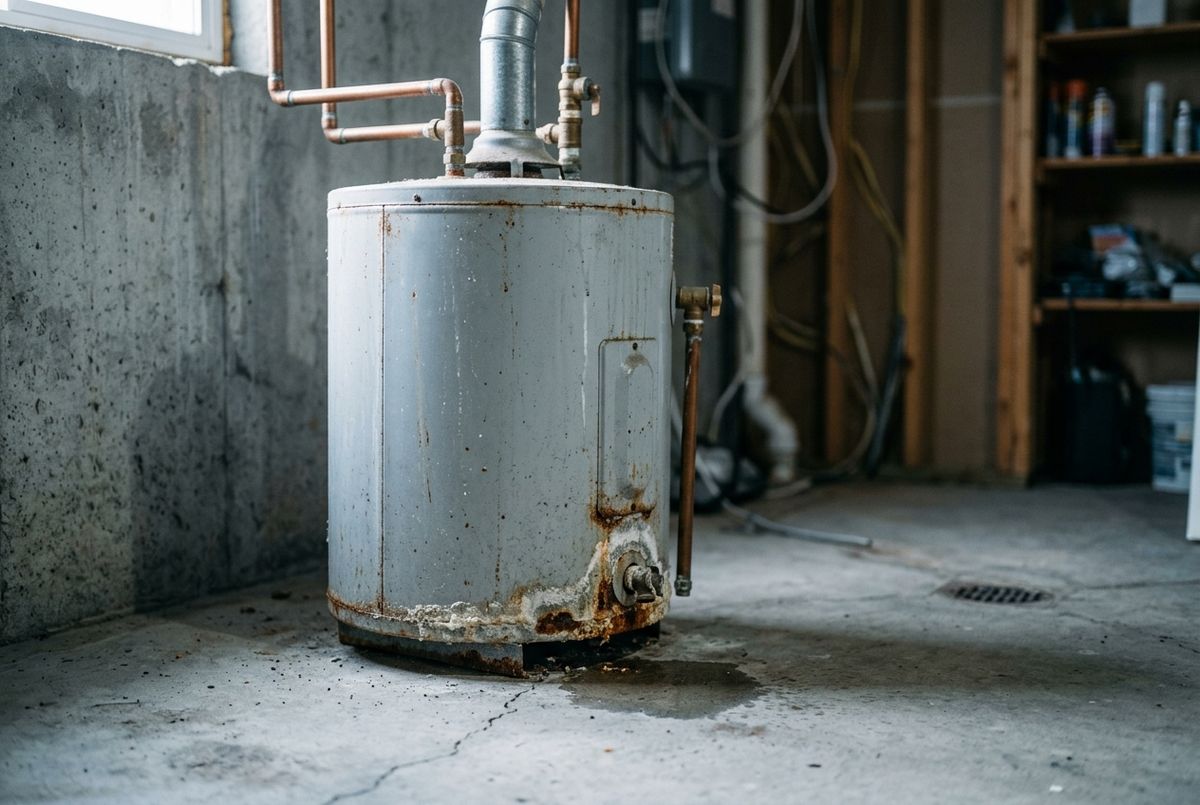
You're being quoted a few thousand dollars more for a tankless unit than for a straight tank swap, and somewhere in the pitch is a line about it paying for itself on the gas bill. Before you decide, it's worth knowing what that saving is worth in Calgary — because it can be worked out from published numbers, and almost nobody does it.
Short answer: the energy saving is real but small. Using Natural Resources Canada's own efficiency figure and Alberta's published August 2026 gas rates, switching an average Alberta household from a storage tank to an ENERGY STAR tankless unit saves roughly $22 a year. Push every assumption in tankless's favour and it still doesn't clear about $84 a year. Against an install premium of a couple of thousand dollars, that is not a payback — it's a rounding error. Buy tankless for endless hot water and floor space, which are real. Don't buy it to save money on gas.
That conclusion is ours, and we'd rather you didn't take it on trust. Here is the calculation, every input sourced, so you can check it or take it to whoever quoted you.
Why the numbers on the ranking pages can't be right
Search “tank vs tankless Calgary” and the first page is entirely companies that install them. Not a scandal — we sell plumbing too. What's worth noticing is the shape of the claims. One Calgary page states a saving of “$150 to $300” a year and “$3,000 to $6,000 over 20 years,” sourcing the efficiency percentage to NRCan and the dollar figures to nothing. Another says payback takes “about a decade,” also with no arithmetic shown.
Sources: Purcell Heating and FlameTech Plumbing & Heating, both selling the installation; neither shows a calculation behind its dollar figures.
Here's the tell. A percentage saving only becomes dollars when you multiply it by the price of energy, and Alberta has some of the cheapest natural gas in the country. A figure that doesn't start from an Alberta gas rate is describing somebody else's house.
One thing those pages haven't caught up with. Several still list carbon-tax savings as a tankless benefit. The federal fuel charge was set to zero after 31 March 2025, all fuel types, Alberta included — there is no carbon charge left on your gas bill to save on.
Source: Department of Finance Canada — removing the consumer carbon price, effective April 1, 2025
The calculation, shown in full
Four published inputs, none of them ours.
- How much gas a household burns heating water. NRCan's Comprehensive Energy Use Database puts Alberta residential water heating at 42.5 petajoules across 1,601.0 thousand households in 2021 — 26.5 GJ per household per year. Our division, their figures.
- How much less a tankless unit uses. NRCan states an ENERGY STAR certified tankless water heater “uses 30% less energy, on average, than a storage tank type.” So the saving is 30% × 26.5 GJ = 7.96 GJ a year.
- What a gigajoule costs at the margin. The August 2026 regulated rate is $1.729/GJ for the gas itself. ATCO Gas South's Low Use delivery adds $1.000/GJ variable plus a fixed $0.876 a day — and the fixed charge is identical whichever appliance you own, so it cancels out. Marginal cost: $2.729/GJ.
- Multiply. 7.96 GJ × $2.729 = $21.73 a year.
Sources: NRCan — Residential Sector Alberta, Table 2 (2021); NRCan — ENERGY STAR tankless water heaters; Direct Energy Regulated Services — gas rates, August 2026; ATCO Gas South rate schedules, 1 January 2026 (AUC Decision 30301-D01-2025). The $21.73 is our arithmetic on those inputs, not a figure any of them publishes.
Where this is soft, stated plainly. The 26.5 GJ averages every Alberta dwelling, apartments and electric ones included, so a gas-heated detached home sits above it. The commodity rate resets monthly — July 2026 was $1.595/GJ, August $1.729/GJ. Riders “L” and “T” aren't in the marginal figure. Which is why the next section stress-tests it rather than resting on one number.
We tried to make tankless win
Take household usage up to 40 GJ — a busy family home. Then take the commodity rate to $4 and even $6 a gigajoule, far above where it sat through 2026.
| Gas commodity rate | At 26.5 GJ/yr (Alberta average) | At 40 GJ/yr (heavy user) |
|---|---|---|
| $1.729/GJ — actual, August 2026 | $21.73 | $32.75 |
| $4.00/GJ — well above 2026 levels | $39.75 | $60.00 |
| $6.00/GJ — a serious price spike | $55.65 | $84.00 |
The most tankless-friendly corner of that table is $84 a year, and reaching it needs a household burning half again the provincial average during a price spike. The lowest figure any ranking Calgary page claims is $150. Turn it around: to save $150 a year on the average household's 7.96 GJ of avoided gas, gas would have to cost $18.84 a gigajoule at the margin — about eleven times the August 2026 rate.
Now put that against the install premium. Calgary companies publish tankless installs at roughly $3,000–$6,500 and conventional tanks at $1,200–$2,500, so call the premium $1,500 to $4,000. At $21.73 a year, simple payback runs from about 69 years to about 184. Even at the impossible $84 corner it's 18 to 48 years, against a unit most people expect to last 20.
Install ranges self-reported by One Stop HVAC and Comfort Union, both selling the installation. No authoritative public source for Calgary installed prices exists — planning ranges, not quotes. Payback figures are ours.
Does 26.5 GJ pass a sanity check? Heating 200–280 litres a day by 50–55 °C takes 15 to 24 GJ of useful heat a year; a storage tank delivers that at roughly 0.6 efficiency, so it burns about 25 to 38 GJ. NRCan's average sits at the bottom of that band — exactly where an average including apartments and electric tanks should sit.
The maintenance side, where Calgary genuinely differs
This is the part of the comparison that is local, and it runs against tankless. The City's 2025 data puts the Bearspaw plant between 141 and 200 mg/L of calcium carbonate through the year and Glenmore between 181 and 274 mg/L. Divide by 17.1 for the grains-per-gallon figure the appliance industry uses — roughly 8.2–11.7 gpg from Bearspaw, 10.6–16.0 from Glenmore, hard to very hard. That conversion is ours; the City publishes only mg/L, and doesn't say which plant serves which neighbourhood, so ask 311 for yours.
Source: The City of Calgary — water quality and hardness data (2025 figures)
Scale forms wherever water is heated. In a storage tank it settles as sediment in the bottom, which is why tanks here come out earlier than the box promises — what scale does to a tank's real lifespan. In a tankless unit it plates a narrow heat exchanger, where a thin layer restricts flow and traps heat against the metal. Same mineral, less room for it.
The consequence is a descaling flush on a schedule, forever — a service call, or a DIY afternoon with a pump and a jug of descaler. We're not putting a dollar figure on it, because we couldn't find one published by anyone who isn't selling the service. What matters is that it's an ongoing cost on the tankless side that the energy saving has to cover before it covers anything else — and at $22 a year, it doesn't. If hard water is what's worrying you, our guide to Calgary hard water and softeners covers the whole question.
Ask for the manual before you sign. We went looking for a manufacturer publishing a hardness threshold — above X mg/L, treat the water or flush this often, or the warranty is affected. We couldn't find one stating a number. That's not proof none exists, but ask the installer for the manual for the exact model quoted and read the water quality and warranty sections yourself. If nobody can produce it, that tells you something.
The cold-inlet argument, and who is making it
You'll see two contradictory claims: local pages say Calgary's frigid incoming water cripples tankless performance, industry pages say cold inlet temperatures are a myth. The most-cited piece on the industry side ran in the American Society of Plumbing Engineers' Pipeline and argues gas tankless units deliver 120 °F water at 5 gallons per minute or more even with cold groundwater. Credible technical read — and written by a technical training developer at Rinnai, a tankless manufacturer. That doesn't make it wrong. It does mean it isn't the neutral referee it usually gets quoted as.
Source: ASPE Pipeline — “Tankless Truth”, authored by a Rinnai America employee; the affiliation is disclosed on the article itself.
We could not find a City of Calgary published figure for the temperature of water arriving at a house in winter, so we won't assert one — be sceptical of any page that does without sourcing it, and ask 311 whether the City publishes distribution water temperatures. Your decision doesn't need it anyway: tankless units are sized by how much flow they can raise by how many degrees, so tell the installer how many showers might run at once in January and make them state the flow the quoted model delivers at winter conditions, not the number on the box. Undersizing is a sizing failure, not a technology failure.
So when is tankless actually the right call?
Often — just for reasons that were never financial.
You keep running out of hot water
It heats on demand instead of storing a fixed volume, so the fourth shower is the same as the first. If your household genuinely runs a 40-gallon tank dry on a weekday morning, that's worth paying for.
You need the floor space back
It hangs on a wall instead of taking a metre of floor — often the deciding factor when someone is fitting a bathroom into a Calgary basement and the utility room is the only space left.
You want to buy one appliance, not two
Tankless units are generally expected to outlast storage tanks, so you may buy once instead of twice. A reason to spend more up front, not a saving — and only if the descaling gets done.
All three are worth money to you specifically, or they aren't — a better basis for spending three thousand dollars than a payback that doesn't survive contact with an Alberta gas bill. If one of them does describe your house, the next question is what the conversion involves here: tankless installation in Calgary — gas capacity, venting, condensate and the hardness limit. If none describe your house, a straight tank swap is very likely the right answer: what a tank replacement actually costs in Calgary.
What to ask before you sign either quote
- Ask them to show the saving arithmetic. How many gigajoules a year does my hot water use, and what did you multiply it by? Any answer is fine. No answer means the number came from a brochure.
- Ask for venting and gas line as their own lines. Venting is what separates a $2,400 tank job from a $3,600 one, and going tankless almost always means new venting. A tankless unit also fires at a far higher input than the tank it replaces, so the gas line may need upsizing — the item most likely to appear as a surprise mid-install.
- Ask who pulls the permit. Once the gas system is altered, a licensed contractor has to — a homeowner can't unless they hold Alberta gasfitter certification. City trade permit fees start at $116.50 as of August 2026 and rise every January 1, so a quote blaming a big number on “the permit” is worth questioning.
- Ask what the descaling schedule and cost will be. In writing, for this model, in this water — then add it to the tankless column before you compare.
Sources: The City of Calgary — homeowner electrical and plumbing permits; City of Calgary building and trade permit fee schedule. Current as of August 2026; City fees increase annually on January 1.
None of that needs you to know anything about water heaters — it just makes it hard to hide a difference in scope inside a difference in price, the same trick we describe on how Calgary plumbers price work. If the tank has already failed, start at no hot water or emergency plumbing. Back to Calgary plumbing basics →
Want the arithmetic run on your actual house?
Send a photo of the tank's label and the gas meter and we'll tell you what your hot water is really costing, what the tankless premium would be on your venting and gas line, and whether it's worth it — including when the answer is no. In writing, before anyone books a date.
Questions Calgary homeowners actually ask
Everyone says tankless saves 30% on energy. Is that wrong?
No, that part is probably about right — Natural Resources Canada says an ENERGY STAR certified tankless unit uses roughly 30% less energy than a storage tank. The problem is what happens next. People hear “30%” and picture 30% off a heating bill. It's 30% off the gas your water heater burns, which in an Alberta house is a small slice of a small number.
Thirty per cent of about 26 gigajoules a year is roughly 8 GJ. Alberta gas in August 2026 costs $1.729 a gigajoule for the gas itself plus a dollar a gigajoule to deliver it. Eight times $2.73 is about twenty-two dollars. The percentage is real. The dollars behind it just aren't very big here, because our gas is cheap.
So is a tankless heater a bad idea in Calgary?
Not at all — it's just a bad idea to buy one to save money on gas. That's the only claim this page is arguing with.
The reasons people are actually happy with them are reasons nobody puts in a spreadsheet. Nobody runs out of hot water when three people shower back to back. You get the floor space in the utility room back, which matters a lot if you're squeezing a bathroom into a basement. And they tend to last longer than a tank, so you may buy one appliance instead of two. If you want those things and you can afford the premium, buy it and enjoy it. Just don't let anyone tell you it pays for itself.
I got a quote saying I'd save $200 a year. Are they lying to me?
Probably not lying — more likely repeating a number that's been copied around the internet for years without anyone checking it against an Alberta gas bill. A lot of those figures started life in the United States, where gas costs several times what it costs here and a percentage saving turns into real money.
The fair way to handle it is not to accuse anyone of anything. Just ask them to show their work: how many gigajoules a year do you think my water heater burns, and what did you multiply that by? If they can answer that, great, compare it to what's on this page. If the number came from a brochure, you both now know that.
Does our hard water wreck a tankless unit?
“Wreck” is strong, but Calgary water is genuinely hard — the City's own 2025 numbers run up to 274 mg/L at the Glenmore plant, which is well into the “very hard” end of the scale. Scale builds up on any surface that heats water, and a tankless unit's heat exchanger is a narrow passage where a little scale matters more than it does in the bottom of a 50-gallon tank.
Practically, that means a descaling flush on a schedule for the rest of the unit's life, either as a service call or as a Saturday job with a pump and a jug of solution. Worth being honest about something: we went looking for a manufacturer that publishes an actual hardness threshold — over this many mg/L, treat the water or flush this often — and couldn't find one. Before you buy, ask to see the installation manual for the exact model and read what it says about water quality and warranty. That's a fair question and a good installer won't mind it.
What about the cold water coming in? Doesn't winter make it worse?
The physics is straightforward: the colder the water arriving, the more energy it takes to get it to shower temperature, and a tankless unit has to do all of that heating in the seconds the water spends inside it. That's why they're rated by how much flow they can lift by how many degrees, rather than by a tank size.
What we can't tell you is the actual number for Calgary. We looked for a published City of Calgary figure for the temperature of water arriving at a house in January and couldn't find one. Rather than borrow a figure from somewhere else and dress it up as local, we'd say ask 311 whether the City publishes distribution water temperatures. What matters for your house anyway is the sizing: tell the installer how many showers might run at once and make them tell you the flow the unit delivers at winter conditions, not the number on the front of the box.
Does swapping a tank for a tankless need a permit?
Yes, and this is the part that catches people. A like-for-like tank swap is one thing, but going tankless usually means new venting and often a bigger gas line, and once you're altering the gas system a licensed contractor has to pull the permit — a homeowner can't do it unless they hold Alberta gasfitter certification.
The permit itself is not the expensive part. City of Calgary trade permit fees start at $116.50 as of August 2026 and go up every January 1. The expensive part is the venting and gas-line work the permit is attached to. We've written up exactly when a water heater job needs a permit here, including the tankless case.