Frozen or burst pipe in Calgary: what to do in the next ten minutes
Written for Calgary homeowners · Last reviewed September 5, 2026
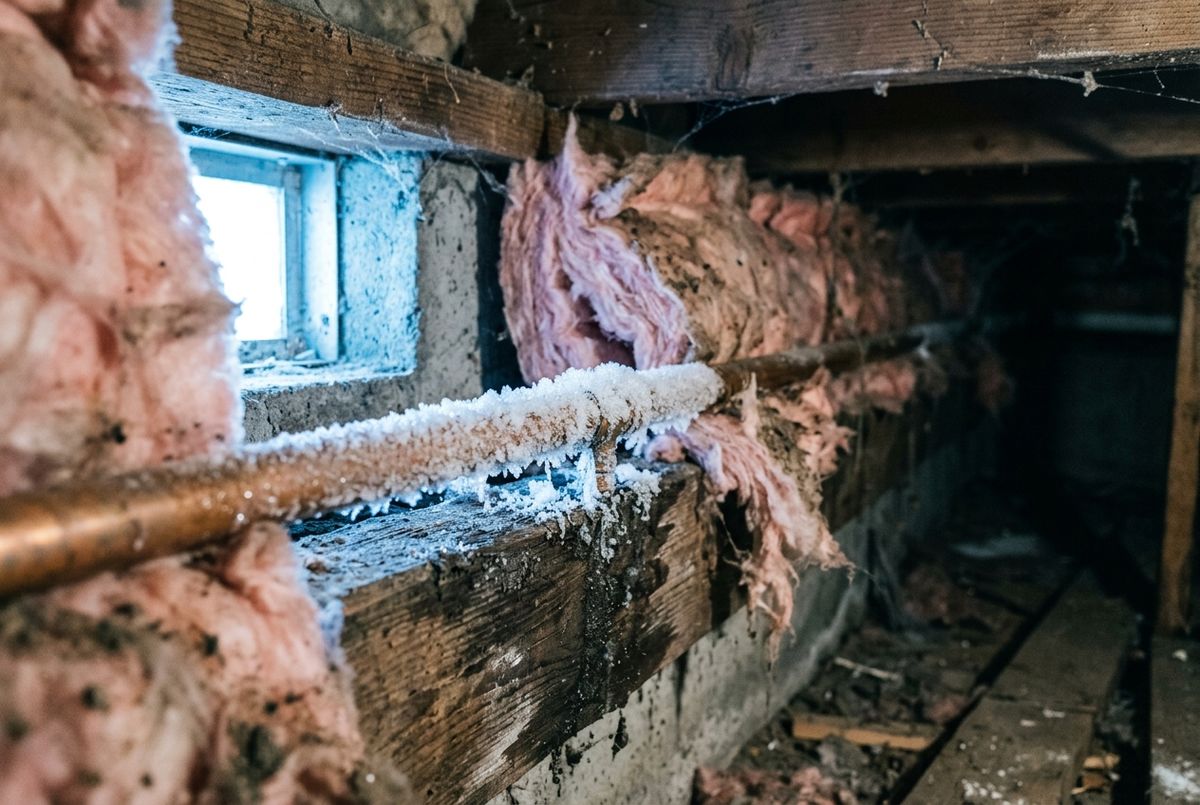
Short answer: If water is coming out, shut off the main first — basement, street-facing wall, usually near the water heater — then cut power to any wet area, then photograph before you touch anything. If the pipe is frozen but still holding, open the tap it feeds and warm the pipe from the tap end backwards with a hair dryer. Never a torch.
Two different jobs, and mixing them up costs money. Pick a path and ignore the other until the water is under control.
It's already burst
Spraying, dripping through a ceiling or pooling on the floor. Every minute costs drywall and flooring.
It's frozen but hasn't burst
No water at one tap, rest of the house fine. Some time — but not much: the split shows up when it thaws.
Path 1: the pipe has already burst
A half-inch supply line at household pressure moves a startling amount of water, so the order below is deliberate.
- Shut off the main. Street-facing basement wall, low down, near the meter and the hot water tank. Clockwise on a round handle; a quarter turn on a lever. Old gate valves here seize constantly, so if it won't move, don't force it into snapping — move on and call.
- Kill the power to anything wet. Live circuits in a flooding basement are the part that can actually hurt you. Breakers off for that area. If the panel itself is in the wet zone, don't wade in: call the utility and stay out.
- Open the taps to drain the system. Lowest cold tap in the house, plus a couple upstairs. That drops the pressure and sends the water sitting above the break down a drain instead of through your ceiling.
- Photograph before you clean up. The room, the split, the water line on the wall, the soaked contents. Adjusters assess what they can see, and a floor you've already mopped is worth nothing to your claim.
- Then extract. Wet vac, towels, fans, contents up off the floor. Speed beats thoroughness, because standing water wicks into drywall within hours.
Find your main shut-off before you need it. The most useful five minutes a Calgary homeowner spends in October: walk to the basement, find that valve and cycle it once to confirm it turns. Discovering it is seized while the ceiling comes down is the difference between a wet floor and a claim.
The valve that is yours to operate is the one indoors: The City puts the main shut-off inside the house on the homeowner, while everything past the property line — mains, main valves and the service valve at the curb — is City property. A seized interior main means 311 and a plumber, not a shovel at the boulevard. We map where the ownership line falls separately.
Source: The City of Calgary — Water service lines in Calgary
Path 2: frozen, but it hasn't let go yet
The tell is localized: one fixture with no water or a weak dribble, everything else normal. If nothing in the house has water, suspect the service line from the street — a 311 call, not a hair dryer job. If water goes in fine but won't go out, that's a frozen sewer line instead.
- Open the tap that pipe feeds first. The step people skip, and the one that matters most. Melting ice releases water, and that water needs an exit: an open tap gives it one and relieves the pressure that would build against the plug. Both hot and cold sides.
- Work from the tap end backwards. Heat closest to the open faucet first, then move gradually toward the frozen section. Heat the middle of the plug instead and meltwater gets trapped between two blocks of ice, which is how a pipe that would have survived splits.
- Use gentle, boring heat. Hair dryer on low, a heat lamp at a safe distance, a heating pad round the pipe, hot towels re-wrapped as they cool. Keep it moving. Slow is correct.
- Warm the room, not just the pipe. Open the cabinet doors under the sink so household heat reaches behind them. A space heater aimed into the cavity, never left unattended, often does more than the dryer.
- Watch the pipe as flow returns. Stay there with a flashlight on the whole run. Freeze splits often don't leak until the ice clears and pressure returns. A bulge, a hairline crack or a bead at a joint means shut the main off again and go to Path 1.
Never use an open flame. No propane torch, no blowtorch, no charcoal or kerosene heater. Superheating the water trapped inside an ice plug can rupture the pipe, and a flame in a wall cavity sits against framing and dust you can't see into or reach with an extinguisher. If you're reaching for a torch, that's the moment to call instead.
Call a plumber if you can't find the frozen section, if it's inside a wall you'd have to open, or if you think it's already split. Our emergency page has an honest call-now versus call-Monday list.
Not sure if it's frozen, burst, or something else entirely?
Describe what you're seeing and you'll get a straight read on whether this needs someone tonight or whether you can safely thaw it yourself, so you're not paying after-hours rates for a hair dryer job. Same principle as the rest of our Calgary plumbing guides.
Where Calgary pipes actually freeze
Rarely a random pipe in a heated room, and a pipe that froze once refreezes in the same spot, because the cause hasn't changed. Failures cluster where building heat doesn't reach:
- Garage walls. A line run through a shared garage wall to a laundry sink, garage tap or the bathroom above: unheated space, barely insulated cavity.
- The outdoor tap run. The section between the interior shut-off and the hose bib is the classic Calgary burst, and it almost always traces back to a hose left on in the fall. The winterizing sequence →
- Rim joists and the sill plate. Where the basement wall meets the floor above. Air leaks there let −30 °C air sit against a pipe that thinks it's indoors.
- Crawl spaces and unheated additions. Converted porches and sunrooms over a crawl space with no heat register.
- Vacant or lightly heated homes. Mid-renovation, between tenants, or the thermostat turned down while the owners winter somewhere warm.
So how long does it take for a pipe to freeze?
Nobody can give you a real number, and be sceptical of pages that do: the internet's favourite "six hours" line is repeated everywhere with no source behind it. Exposure, wind, insulation, pipe material and whether water is moving decide it. A well-insulated pipe in a wall cavity can ride out a week at −25 °C; an uninsulated line in a windy crawl space can freeze overnight at −12 °C. Bare ground is harder on plumbing than deeper cold under a foot of snow, because snow is insulation.
The one number worth acting on comes from The City: keep the thermostat at at least 15 °C, use only UL-listed heat tape or pipe sleeves, and make sure lines to outside faucets and hoses are turned off, disconnected and drained. That figure is aimed at empty houses set to 10 °C to save gas, which is where most of this city's frozen service lines come from.
Source: The City of Calgary — Protect your water lines and meter from freezing
Who pays — and the water meter trap
Same split as any other water service issue: the City owns the pipe to your property line, you own it from there to the house, and that boundary usually sits only a few metres in from the curb. A freeze two metres on the wrong side of it is entirely your bill.
The exception homeowners rely on is the meter, which The City normally owns. Not here — the City spells out that the owner's repair costs on private property include missing, damaged or frozen water meters. It catches people out every winter, because the meter sits in the coldest corner of a cold basement: one more argument for the 15 °C rule and for leaving the utility-room register open.
Source: The City of Calgary — Protect your water lines and meter from freezing. The full ownership breakdown, with the 311 script →
What happens when you call 311
If the frozen section looks like the service line into the house (no water anywhere, deep cold snap) report it to 311. As of September 2026, the City describes the process this way:
- The City will contact you and may send a crew to confirm the service is actually frozen rather than take the report at face value.
- Response times may be delayed due to high volumes. In the week a cold snap breaks everyone calls at once, so plan around it.
- You must complete a Work Authorization Form before the City will thaw the private portion. Read it first: it sets out what you're agreeing to.
- If your service is identified as at risk of freezing this winter, you get a letter from The City. Not junk mail. See below.
Source: The City of Calgary — Protect your water lines and meter from freezing
The letter that lands in December
The program monitors frost levels and flags services likely to freeze; letters go out between December 1 and March 31. The ask is specific: leave one inside tap running 24 hours a day at roughly the width of a pencil, and don't shut it off until a follow-up letter says to. And the part that decides whether people comply: metered residential customers on the program are billed a flat 7 m³ per month for water and wastewater, so a tap running all winter costs a known fixed amount, not whatever the meter would otherwise record.
Source: The City of Calgary — Frozen Pipes Prevention Program
We're deliberately not telling you what the City charges to thaw a service line, or what happens if crews attend and the freeze turns out to be entirely private-side. Neither could be verified from a City source, and inventing a figure would be worse than saying so. Ask 311 when you report it, before a crew is dispatched.
Insurance: the part people find out too late
Alberta burst-pipe claims get disputed over two things: whether the house was being checked, and whether the damage was sudden or slow neglect. An Alberta brokerage states most insurers require a vacant home to be checked every 24 to 72 hours for this type of claim to be covered, and that clogs and high water pressure count as maintenance and most likely aren't covered. It also points to service line coverage, sometimes bundled into a comprehensive package and sometimes not, as what covers burst pipes caused by tree roots, shifting earth and corrosion, so the buried run from the property line to the house is covered only if you carry it.
Source: Acera Insurance — Are burst pipes covered by home insurance in Alberta?
That's one brokerage's description, not a universal rule and not your policy. Read your own vacancy clause before you book a January flight.
If your first sign of trouble was a water bill that jumped rather than water on the floor, that's a different hunt: start with finding a silent leak, or how a buried leak gets located, where the City's free 311 locator is the first call. For what the repair runs, our page on plumber rates is blunt about how little authoritative pricing data exists here.
Questions Calgary homeowners actually ask
One tap has no water but the rest of the house is fine. Is that a frozen pipe?
Almost certainly, yes — if it happened during a cold stretch and nothing else in the house changed. A freeze is local. It plugs the one run of pipe that got cold, so you lose that fixture and nothing else. Very often it's a kitchen sink on an outside wall, a laundry tub in the garage, or a bathroom above an unheated space.
The comparison that tells you it's something else: if every tap in the house is dead in the middle of a cold snap, look at the service line coming in from the street rather than anything inside your walls, and call 311. And if water goes down the drains fine one day and backs up out of the floor drain the next, that's a sewer problem, not a supply problem — two different pipes, two different fixes.
Should I leave a tap dripping when it gets really cold?
It's the standard advice and it does work for the specific pipes you're worried about — a bit of movement in the line makes an ice plug much harder to form, and a dripping tap keeps the pressure down if one does start. If you know which run froze last time, that's the tap to leave running a pencil-thin stream on both hot and cold.
Two honest caveats. It's metered water in Calgary, so leaving every tap in the house running for a week isn't free — the flat 7 m³-a-month billing only applies if the City has put you on its Frozen Pipes Prevention Program, not if you decided to do it yourself — and it does nothing for the pipe you didn't think about. The bigger wins are keeping the house at or above the 15 °C the City recommends, opening the cabinet doors under sinks on outside walls, and sealing whatever gap is letting outdoor air onto that pipe in the first place.
The City sent us a letter about frozen pipes. Is that a real thing or junk mail?
It's real. The City runs a Frozen Pipes Prevention Program that watches frost levels and identifies homes and businesses whose water service is at risk, using historical data and installation information, and letters go out to those addresses between December 1 and March 31. If you got one, your address is on that list for a reason.
Worth taking seriously, because the private side of the service line is your bill, not the City's — including a frozen or damaged water meter, which is the one exception people always get wrong. Read the letter and do what it says: one inside tap running around the clock at roughly the width of a pencil, left on until a follow-up letter tells you to stop. If it's a rental or a place you don't live in, make sure whoever is there over the winter knows that and knows about the 15 °C minimum.
We're away for six weeks in the winter. What do we actually have to do?
Set the furnace at 15 °C or higher, not 10 °C — the savings on gas are not worth the risk, and 15 °C is the number The City publishes for protecting the service line. Shut off the water at the main and drain the system down if nobody will be in the house at all. Disconnect any garden hose, open the outdoor tap and bleed the line to it. Leave cabinet doors open under sinks on exterior walls.
Then the part people forget: have a real person physically go into the house on a schedule. An Alberta brokerage says most insurers want a vacant home checked every 24 to 72 hours for burst-pipe damage to be covered. That's their description rather than a universal rule, so pull out your own policy and read the vacancy clause before you book the flight. Keep a text log of the visits — it costs nothing and it's exactly the evidence an adjuster asks for.
A pipe burst while we were out. Should I clean up first or call insurance first?
Stop the water first — main shut-off, breakers off for the wet area — then get your phone out and document before you move a thing. Wide shots of the room, close-ups of the split pipe, the water line up the wall, the soaked boxes, the ceiling stain. Then start extracting water, because standing water keeps doing damage while you wait for a call back.
You don't have to choose between mitigating and documenting, and your policy almost certainly requires you to limit further damage. What you must not do is have the basement tidy and the ruined contents at the curb before anyone sees it. Adjusters assess what's in front of them, and photos taken in the first ten minutes are worth more than any description you write later.
Can I thaw it with a propane torch? My neighbour does it every year.
No, and your neighbour has been lucky. Two things go wrong. Superheating water trapped inside an ice plug can rupture the pipe far more violently than the freeze would have, and thawing inside a wall cavity puts an open flame directly against dry framing, old paper-faced insulation and decades of dust, in a void you can't see into and can't reach with an extinguisher. A pipe run inside a wall is surrounded by the most combustible material in your house, and a smouldering start in there can burn unnoticed for a long time before it reaches a room.
Hair dryer, heat lamp, heating pad or hot towels, always with the tap open and always working from the tap end back toward the ice. It's slow and boring, and that's what makes it safe. If the pipe is somewhere you can't reach without opening a wall, that's the point to hand it to someone with a proper thawing setup rather than escalating to fire.