Sewer camera inspection in Calgary: what you should actually get for your money
Written for Calgary homeowners
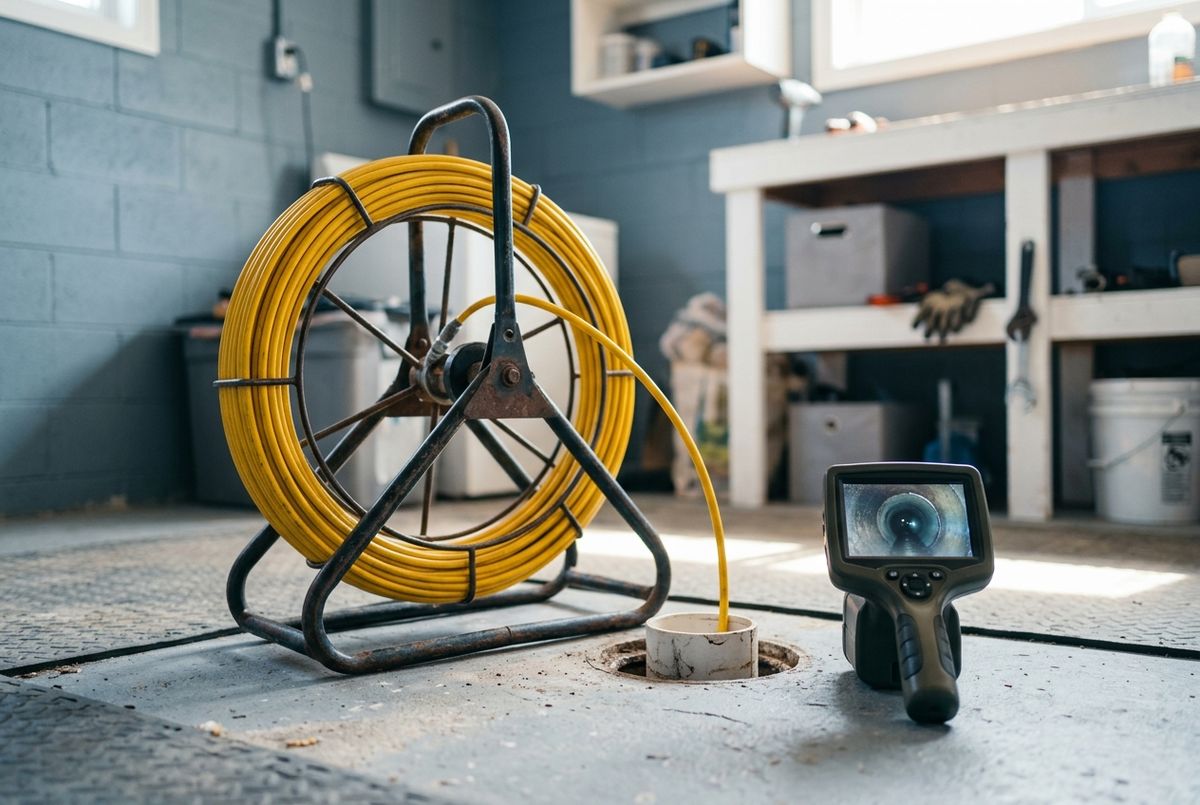
The same drain has backed up twice since spring, or somebody has told you the main line needs replacing, and now there's a camera inspection on the quote. What you're really asking is whether that's a diagnostic or an upsell — and what you should have in your hand when the van pulls away.
Short answer: a camera run is worth paying for when a decision depends on it — a repeat blockage, a recommended replacement, a basement about to be finished, a trench about to be dug. It isn't worth it on a first-time clog. What you're buying is the record, not the look: footage you keep, the distance to each defect, the pipe material, and the point the run started from. No authoritative source publishes a Calgary price, and of the pages ranking for this service that we read on 23 November 2026, not one published a figure either. If sewage is backing up right now, the first call is 311, not a plumber.
If you're buying a house rather than fixing one, the same tool has a different job and a different clock — that's a sewer scope inside a conditions period. If the line is blocked at this minute, start with drain cleaning.
What the camera settles, and what it leaves open
A push camera goes in through a cleanout — in most Calgary houses there's one in the basement near where the sewer leaves the foundation — and runs out towards the street. It settles some things completely, others not at all.
What the pipe is made of
Clay tile, cast iron, ABS and PVC are all recognisable on camera, so you find out what you own instead of inferring it from the build year — and because lines get partially replaced, that inference is often wrong. More in what your pipes are made of.
How far out the problem is
The distance reading is the most valuable number on the report: it decides where a trench goes and, read beside your property line, whose bill it is. Insist it's written down, not narrated.
Maintenance or repair
Fine roots at one joint and a root mass filling the bore are the same phrase on an invoice and completely different jobs. Seeing which you have stops you agreeing to a replacement you didn't need — or augering a line that's past it.
What it can't tell you
The camera is inside the pipe, so it says nothing about depth, soil or bedding — and those are most of the cost of any dig. It also gets stopped by hard blockages, tight bends and collapses, so settle up front what you owe if the run can't be finished.
Nobody in this city will publish a price — including us
We read the Calgary pages currently ranking for this service on 23 November 2026, to see what a homeowner is told before they phone. Not one publishes a figure. One says it has "upfront pricing" and gives no number. All three explain that the price varies with access, pipe length and scope — true, and no use when you're budgeting.
Pages read 23 November 2026: Harper's Plumbing, Mr. Mike's Plumbing, The Drain Doctor. None of the three cites a source, standard or bylaw anywhere on the page.
So here's the only honest frame, and it's a planning estimate rather than a quote. There is no authoritative public source for Calgary plumbing rates; every published figure here is a company's own self-report. One Calgary plumber publishes hourly rates of roughly $85–$120 for an independent, $95–$150 for a company and $150–$250 after hours. A camera run on an accessible cleanout is commonly an hour or two, so that's the territory to budget — not a number anyone has promised you.
Rates self-reported by Mr. Mike's Plumbing, updated December 2025; last confirmed by us 16 August 2026. Not audited, not a quote. See what plumbers charge in Calgary.
The question that actually controls your bill: is the camera charge credited against the repair if you proceed? Settle that on the phone. An inspection fee that quietly becomes a deposit on a repair you haven't agreed to is the common way this goes wrong.
The City writes a specification for the camera run on its own sewers. Nothing covers yours.
This doesn't appear on a single competing page, and it reframes the purchase. When sewers are built in Calgary the camera run isn't left to whoever shows up. The City's Standard Specifications Sewer Construction carries a dedicated section, 403.13.05, titled "Image-Based Sewer Inspection," inside the acceptance-testing group — the tests a sewer must pass before the City will take it on. The 2020 edition's own revision list describes the changes made to it: "Revised section on video review / added penalty table," "Revised video requirements," "Revised submission to City requirements," and next door, "Revised max pipe size for image based inspection to 1500mm."
Source: The City of Calgary — Standard Specifications Sewer Construction (2020), revision list and table of contents; the 2022 edition carries the same section. Both opened 23 November 2026.
What we could not read, and won't pretend to have: both PDFs stopped returning text before 403.13.05 itself, so we have the section's title, its place in acceptance testing and the revision notes above — not the clause. What video format, defect coding or operator qualification it specifies, we can't tell you. Two further limits: the specification governs City-owned sewer infrastructure and new development construction, not an existing private lateral; and we found no published Alberta standard governing a residential lateral inspection — so if a company says its inspections are "done to standard," ask which standard, and whether they'll name it on the report.
The conclusion is uncomfortable but useful: on your side of the property line, you are the specification. Nobody fails a video review or pays a penalty for a sloppy run on your lateral. So agree the deliverables before the camera goes in.
- The recording, handed over, in a format you can open. Not a live look at a monitor. Two of the three pages we read offer footage on a USB stick or by Dropbox; the third describes live video only. Ask which you're getting.
- A distance log, in metres, from a stated starting point. "Eleven metres" means nothing unless the report says eleven metres from where — the basement cleanout and the foundation wall aren't the same datum.
- The pipe material, and where it changes. A transition from cast iron to clay tile part-way out is exactly the thing that decides a repair method.
- Each finding named and ranked in writing, with a still image — root intrusion, offset joint, belly holding water, crack — and what needs doing now versus what can be watched. That is what makes the report usable by a second plumber without a second inspection, and none of the three pages we read mentions a written report or any grading at all.
None of that needs a permit, incidentally. The City lists removing a blockage in the drainage system as work that does not require one, and looking at a pipe is less than that — but a permit is required when water and sewer lines in or around the home are replaced, so what the camera recommends may well need one.
Source: The City of Calgary — Trades permits. Last confirmed 21 September 2026. See what you can legally do yourself.
Before you pay anyone: the free call
If you're here because sewage is coming up into a floor drain, the sequence matters more than the supplier. The City's procedure is that you call 311, and a 311 agent determines whether the problem is your internal plumbing or possibly City infrastructure. If it's on the City's side, that's not an inspection you should be funding; if the blockage is on private property, the City says the customer is advised to call a plumber. Ten minutes either way, and it rules out the expensive misunderstanding.
What the City won't do is find it for you indoors: crews "will not move furniture, pull back carpet, remove toilets or make holes in drywall to identify the source of the backup." That part is a plumber's job, and where the camera earns its keep.
Source: The City of Calgary — Sewage backups. Last re-opened and confirmed by us 21 September 2026; we could not reach the page on 23 November 2026, so confirm current procedure with 311 if it matters to a decision. If water is actively spreading, deal with that first — see emergency plumbing.
A distance only means something next to your property line
This is the arithmetic that turns a camera report into a bill. In Calgary, The City owns the water and sewer service lines from the mains up to your property line, and you own the run from the property line to the house — and you pay all repair costs on that private-side portion. The property line typically sits only a few metres in from the edge of the curb or sidewalk, far closer to your house than most people picture.
Source: The City of Calgary — Water service lines in Calgary; see also Installing water and sewer connections. Last confirmed 21 September 2026.
So pull your Real Property Report and read it beside the distance log. If the defect lands clearly inside your boundary it's yours, and what happens next — trenchless versus open-cut, who may dig once the work crosses into the right-of-way — is on our sewer line repair page. If it looks close to the line, phone 311 with the address and the distance instead of accepting anyone's reading of it, and read who owns which pipe first so you know what to ask. Our main Calgary plumbing guide covers the rest.
The camera is also the only map of your lateral
The second use of this service gets almost no attention locally, and it's the one that saves money before anything goes wrong. Before any ground disturbance in Alberta, buried utilities must be marked — mandatory, not a courtesy — and the locate is free. But it covers the utilities' lines. Customer-owned water and sewer past the shut-off at the property line are explicitly out of scope: the utility owners don't know where they run, so finding them falls to you.
Source: Utility Safety Partners — FAQ and Homeowner overview. Quoted facts last confirmed by us 21 September 2026; we could not re-open these pages on 23 November 2026.
A camera with a transmitter in the head can be tracked from the surface, so the visit that inspects the line can also mark where it runs and roughly how deep. That's worth an hour before you plant a tree in the front yard, pour a garage pad, drive deck piles — or commit to a basement bathroom, because what you're tying into decides the design. Ask whether locating is included or extra. It often isn't, and it's cheap to add while they're there.
A Calgary timing note. If the line has given trouble in deep winter, get the camera in before the ground freezes solid. A frozen sewer line and a failing one look alike from inside the house, the City publishes no frozen-sewer guidance at all, and the inspection is how you tell them apart.
Want to know whether a camera run is worth it on your house?
Tell us the age of the house and what's actually happening — how often, which fixtures, what you've been told so far. If a camera won't change your decision, we'll say so. If it will, you get the footage, the distances and a written report you can take to a second opinion.
Questions Calgary homeowners actually ask
The plumber says he won't quote the repair until he's cameraed the line. Is that just another charge?
It's a fair ask, and the reason is less about the pipe than about the hole. The price of a sewer repair is mostly the price of getting at the pipe — how deep, how long, what's on top of it, and whether the dig crosses your property line into the boulevard. A camera gives him the distance to the defect, which is what tells him where the trench goes. Without it he's either guessing or padding, and padding is what you actually don't want.
Where it stops being fair is when the camera charge is vague. Ask whether it's credited against the repair if you go ahead with him, whether you get the recording either way, and what you owe if the camera can't complete the run. Any plumber who's happy to answer those three on the phone is probably fine. One who won't put a number on the inspection isn't going to put a firm number on the repair either.
Can I rent a camera from a tool place and do this myself?
You can rent one, and for looking at a kitchen branch or confirming you've actually cleared something, it's fine. Nothing about running a camera down your own drain needs a permit — the City lists removing a blockage in the drainage system as work that doesn't require one, and looking at it is considerably less than that.
The catch is that a cheap rental camera gives you a picture and nothing else. It usually has no distance counter, so you can see a problem without being able to say how far out it is — and on a Calgary lot the whole question is whether the problem sits before or after the property line, because that decides whether it's your bill. It also has no transmitter, so you can't mark the pipe's path on the surface. If you're just curious, rent one. If a decision or a quote depends on the answer, the distance log is the thing you're actually paying a pro for.
Sewage came up through the basement floor drain last night. Camera first, or phone first?
Phone first, and the first call is 311 rather than a plumber. The City's own procedure is that a 311 agent determines whether the problem is your internal plumbing or possibly City infrastructure, and if it turns out to be on the City's side of things that's not a camera you need to be paying for. If it's on your private property, the City says plainly that you'll be advised to call a plumber — so you've lost ten minutes and ruled out the expensive misunderstanding.
Don't expect them to come inside and find it for you, mind. The City states that crews will not move furniture, pull back carpet, remove toilets or make holes in drywall to identify the source of a backup. That part is yours. And if water is actively spreading while you're on hold, deal with that first — stop using water in the house, keep people off the wet floor, and get a plumber moving.
He showed me the screen in the back of the van and said the line's had it. Is that enough to act on?
No, and this is the part worth being stubborn about. A live picture on a monitor in a driveway is a sales aid. What you can take to a second plumber, an insurer or a seller is a file: the recording, the distance to each thing he's pointing at, what the pipe is made of, and where the run started from. Ask for all four before he packs up, because once the van leaves, a re-inspection costs you again.
We looked at what the Calgary companies currently ranking for this service promise on their own websites, and the pattern is thin. Two of the three say you get the footage on a USB or by Dropbox; the third describes live video only. None of them mentions a written report with distance readings, and none mentions grading what it finds against any standard. That's not an accusation — it's a reason to agree the deliverables out loud, in advance, rather than assuming them.
How often should I get the sewer line looked at?
We're not going to give you an interval, because nobody who'd know publishes one. You'll see "every two to three years" on Calgary plumbing websites with nothing behind it, and the City publishes no recommended inspection schedule for a private sewer lateral at all. An invented number is worse than no number.
What's defensible is that a camera run is event-driven, not calendar-driven. Worth it when the same line has blocked twice, when someone has recommended a replacement and you want evidence instead of an opinion, before you finish a basement, and before you dig in the front yard. Not worth it because a year has gone by and nothing's wrong. If you want the honest version of that list, our drain cleaning page works through it.
The report says "offset joint at 11 metres." Is that mine or the City's?
It depends entirely on where your property line falls, and that's a number the camera can't give you. In Calgary The City owns the sewer and water service from the main up to the property line, and you own the run from the property line to the house and pay all the repair costs on that private-side portion. The property line typically sits only a few metres in from the edge of the curb or sidewalk — not at the road, which is where most people assume it is.
So take the distance from the report and the Real Property Report for your lot, and put them next to each other. Eleven metres from a basement cleanout on a deep inner-city lot is almost certainly still yours. If it looks close, call 311 with the address and the distance before you accept anybody's version of it — and read who owns which pipe first so you know what you're asking.